








Christmas Wreath Ideas 2026: 15 Looks for the Front Door, Plus How to Choose, Hang & Keep One Fresh

The wreath is the first hello of Christmas. It is the one decoration every visitor sees before they step inside, the thing that turns an ordinary front door into a welcome, and the decoration that stays up the longest — from the first weekend of December right through to the New Year. A good wreath does more work than any other single piece of Christmas decor, and it asks for almost nothing in return: one nail, one hook, and a little care.
And yet most wreaths are bought in a hurry, in the wrong size, and hung with a nail that was already in the door. This guide fixes all three. It is the full how-to the listicles skip: how to choose the right wreath for your door, fifteen looks that work in 2026, how to build one yourself in an afternoon, how to hang it so it stays put, and where else in the house a wreath earns its keep. Christmas Day 2026 falls on Friday, December 25, so a wreath hung the weekend after Thanksgiving gives you about four weeks of welcome. Planning the whole house? Start with our Christmas decor ideas for 2026, our tree decorating guide, and our mantel decor guide — the wreath above the mantel is the same method, indoors.

How to Choose: The Size Rule, the Door & Fresh vs Faux
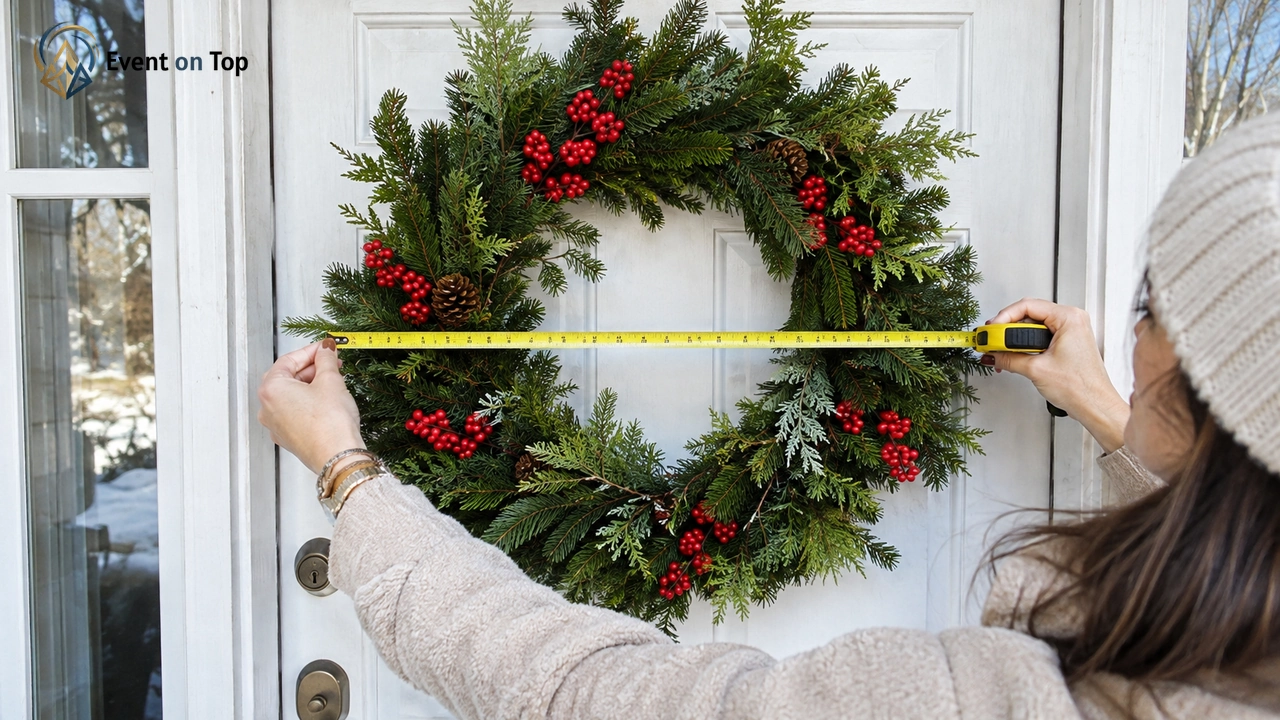
Start with size, because it is the mistake almost everyone makes. A wreath should be roughly half the width of the door it hangs on. On a standard front door, which is about 36 inches wide, that means a wreath of 24 to 26 inches across — big enough to read from the street, small enough to leave a generous frame of door around it. A wreath smaller than 20 inches disappears on a full-size door. A wreath wider than 30 inches crowds it and bangs against the frame every time the door opens. Measure the door before you shop, and if you are choosing between two sizes, take the bigger one: wreaths always look smaller on the door than they do in the shop.
Next, read the door. A wreath should contrast with the surface behind it, or it vanishes. Dark green and deep red wreaths glow against white, cream and pale grey doors. Pale, frosted and white-berry wreaths need a dark door — navy, black, forest green or natural wood — to show up at all. A red door, the classic Christmas choice, wants greenery with texture rather than more red: cedar, eucalyptus, pinecones and a cream or gold bow. And think about the light. A north-facing door in shade will make a pre-lit wreath earn its keep at dusk, while a sun-facing door will bleach a fresh wreath fast — faux holds its colour better there.
Fresh or faux is the other big decision, and both are right for different houses. A fresh wreath smells like Christmas the moment you open the door, and nothing artificial matches it. Kept outdoors in cool weather and misted every few days, a fresh evergreen wreath lasts two to four weeks — hang it in early December and it will see you through Christmas Day, though it will be drying out by New Year. Faux wreaths have improved enormously: the good ones mix pine, cedar and fir tips, hold their shape in wind and rain, and come back out of the box next year looking the same. If your door gets direct sun, if you want the wreath up in November, or if you want to buy once and reuse it, buy faux. If the smell matters more than the lifespan, buy fresh — and buy it from a local grower or garden centre rather than a supermarket shelf, where it may already be a week old.
15 Looks That Work in 2026
The 2026 season has two clear directions, the same pair running through our decor, tree and mantel guides. One is quiet and natural: layered greenery, wood tones, dried elements, texture instead of colour. The other is luminous and full: jewel tones, velvet bows, brass and lots of light. Both work on a wreath. Pick the direction that matches your door and your house, then pick a look inside it.
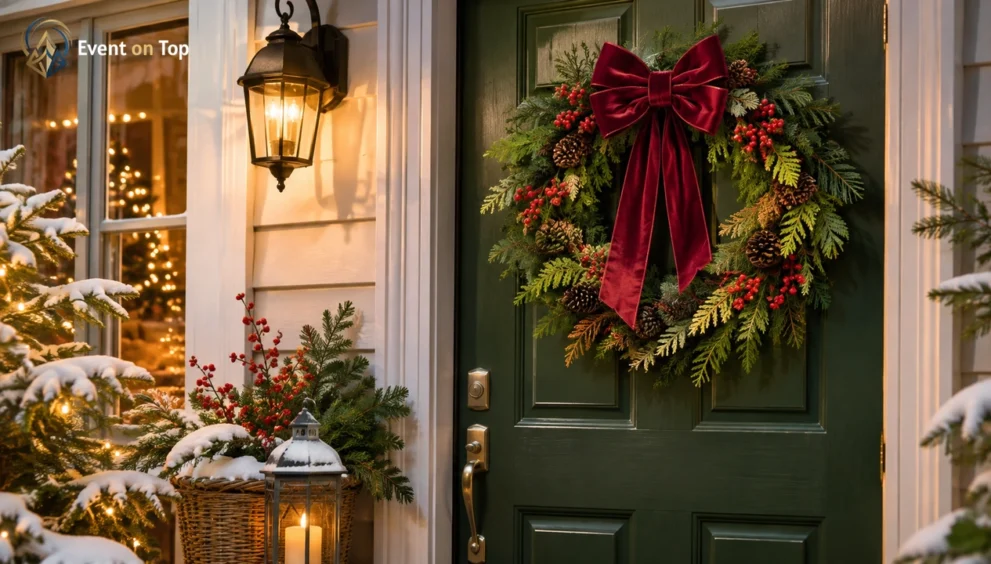
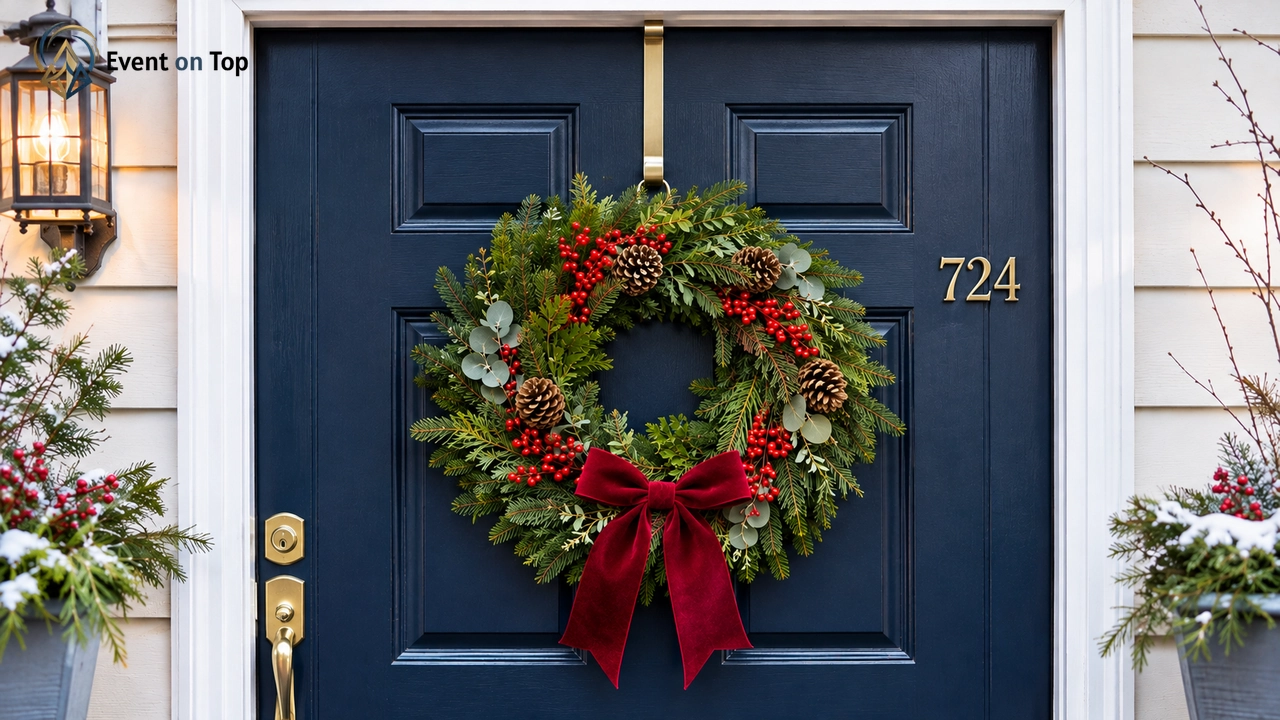
1. Classic evergreen with red berries. The wreath everyone pictures when they hear the word: noble fir and cedar, red berries, pinecones, a deep red velvet bow at the bottom. It works on every door colour and never dates. The 2026 update is matte berries instead of shiny ones, and a bow tied in a loose, soft loop rather than a stiff rosette.
2. Cedar and eucalyptus, silver-green. The quiet-luxury wreath: cedar layered with silvery eucalyptus, almost no colour at all, maybe a few white berries. It looks calm and expensive on a dark door, and it is the wreath that photographs best in daylight.
3. Dried orange and cinnamon. Dried orange slices glow like stained glass when the porch light hits them, cinnamon sticks add scent, and the warm orange-brown palette feels earthy and fresh for 2026. A lovely choice for a kitchen door or a wreath hung indoors.
4. The oversized velvet bow. Bows are bigger and bolder for 2026 than they have been in years, and the wreath is where the trend started. One enormous velvet bow — burgundy, forest green or black — tied at the bottom of a simple evergreen ring. The bow is the decoration; the greenery just frames it.
5. Frosted and white. A flocked or frosted wreath with white berries, silver baubles and a white or pale grey bow. Serene and surprisingly dramatic, especially on a dark door at dusk with the porch light on. Warm white fairy lights are non-negotiable here.
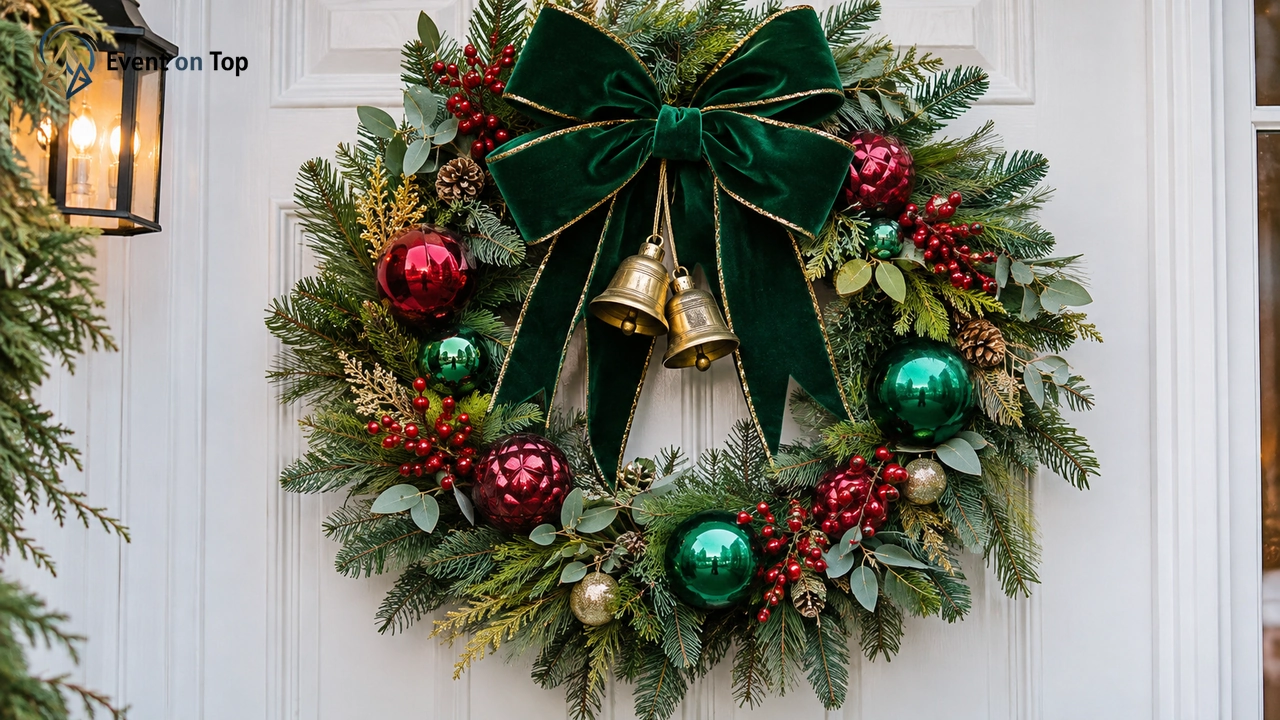
6. Jewel tones and brass. Emerald, ruby and deep plum with brass bells and a brass bow — the same palette our maximalist guide uses on the tree, shrunk to door size. Rich, and it photographs beautifully against a white door.
7. Natural and foraged. Grapevine base, real pinecones, dried seed heads, bare twigs and a slightly wild, asymmetrical shape. No symmetry, no glitter, just texture. The easiest look to build from a walk in the woods and a garden centre.
8. The ornament-cluster wreath. A ring packed tight with baubles in one colour family — all gold, all red, all jewel tones — until no greenery shows at all. Bold, joyful and the best choice for a house with children, because it reads as pure celebration from the street.
9. Scandi minimal. A thin wire or plain evergreen ring with three things on it: a few pine sprigs, a wooden star, a length of natural twine. Restraint is the whole point. Three beautiful pieces beat thirty average ones, and this is the wreath for a modern house with clean lines.
10. Farmhouse plaid and pinecones. Chunky plaid ribbon, pinecones, a few sprigs of red berries and a small wooden sign. The wreath version of a warm hug, and the natural partner to a plaid doormat and a galvanized bucket of pinecones on the porch.
11. Coastal and calm. Driftwood pieces, white and pale blue, dried starfish or shells mixed with greenery. Unusual for Christmas, and exactly why it works — especially on a beach house or a pale blue door.
12. Pre-lit, done properly. A wreath with warm white lights woven through the greenery, on a battery timer so it glows from dusk to bedtime without a thought. The trick is buying one with the lights inside the greenery rather than draped on top, and choosing warm white unless the wreath is all-white or black-and-white.
13. The half wreath, or swag. Not a ring at all: a teardrop of greenery that hangs top-down, like a bouquet, from a hook or a door knocker. The best choice for a narrow door, a storm door, or a door with a window that a full ring would cover.
14. Vintage bauble and tinsel. The nostalgic wreath: vintage-style glass baubles, a little tinsel, a velvet bow, the look of a 1960s Christmas card. It pairs beautifully with the retro ornaments on the tree and it is the wreath most likely to make a neighbour smile.
15. The double wreath. Two matching wreaths — one on the door, one on the window above it, or a matching pair on double doors. The most polished look of the season, and the cheapest way to make a frontage look deliberately decorated rather than accidentally festive.
Whichever look you choose, keep the palette to three colours plus one metallic. Most cluttered wreaths are really just too many colours competing in a small circle, and the three-colour rule is the fastest fix there is.
DIY: Build One in an Afternoon
A handmade wreath is the one decoration that genuinely beats the shop version, because it carries your taste and your greenery. Start with a base: a grapevine ring is the easiest and most forgiving, a foam ring is the neatest, and a wire frame is the lightest for a big wreath. You will need floral wire, a hot glue gun, and secateurs. That is the whole toolkit.
Build in layers. First, attach the greenery in small bunches, working around the ring in one direction and overlapping each bunch so the stems hide under the next. Mix two or three types — cedar for fullness, fir for structure, eucalyptus for colour — and step back every few minutes to check the shape from a distance. Then add the texture: pinecones and berry picks wired in, dried orange slices glued on, a few sprigs of something unexpected. Then the bow, tied separately and wired on last so you can move it. The whole job takes an afternoon, and the first one is always the wonkiest — the second one is the one you keep.
Two practical notes. Wear gloves: cedar and fir sap is sticky and pine needles are sharp, and a fresh wreath built bare-handed is a miserable afternoon. And if you are foraging greenery, take it from your own garden or with permission, and never strip a whole branch — snip the tips, leave the tree its shape, and the garden will not notice.

Hanging It So It Stays Put
A wreath falls down in exactly one way: the hanger fails. A wreath full of baubles and a big bow weighs more than it looks, and a single nail in soft wood or a suction cup on a cold, damp door will give way on the first windy night. Use a proper over-the-door wreath hanger — a flat metal hook that slides over the top of the door — and check that it clears the frame when the door closes. They come in depths to match your door, so measure the thickness before you buy.
If the door is glass or you cannot use a hook, a magnetic wreath hanger is the answer: two strong magnets, one on each side of the glass, that hold through the pane. Suction cups work only on perfectly smooth, clean, dry glass, and they fail in the cold — test one indoors first and never trust it on a door that slams. Whatever you use, hang the wreath so its centre sits at eye level, about 57 inches from the ground, and step back to check it from the street, not just from the porch. A wreath hung too high is the second most common mistake after the wrong size.
For a storm door or a door with a window, hang the wreath on the inside of the storm door or use a swag instead — a full ring pressed against glass will rattle and mark the pane. And if the wind is a problem on your street, tie the wreath to the hanger with a short length of wire as a safety line. It is invisible, and it is the difference between a wreath and a wreath in the neighbour’s garden.
Beyond the Front Door
The front door is the wreath’s natural home, but it is not its only one. The same ring, hung on the wall above the mantel, is the classic finishing piece for the whole living room — our mantel guide uses exactly this, and the 2026 trend is a wreath with a wide ribbon sash tied in a big bow at the bottom. Hung in a window, a wreath turns the house into a Christmas card from the street, especially with a light behind it at dusk. Laid flat on a table with a pillar candle in the middle, it becomes a centrepiece. Hung on a mirror in the hallway, it doubles the greenery and the light.
Small wreaths earn their keep everywhere: on the back of a dining chair, on a bedroom door, on the pantry door, on the garden gate. The rule is the same as the mantel — repeat the look, do not invent a new one. One style of wreath, in two or three sizes, through the whole house, looks deliberate. Five different wreaths in five different styles looks like a shop clearance.

Budget & Timing
A wreath is the cheapest big win in Christmas decorating, because the pieces that do the most work are also the cheapest. A grapevine base, a few bunches of greenery, a roll of wide velvet ribbon in your lead colour and a bag of pinecones cost very little, and the ribbon alone will do more for the look than a bag of baubles in the wrong colour. Shop your own garden first, and buy secondhand where it suits you — charity shops and flea markets are full of brass bells, vintage baubles and ribbon for a fraction of retail.
Buy the base and the greenery first, the ribbon second, and the baubles last. If you are buying fresh, buy it as late as you can stand it — a fresh wreath bought in early December will still look good on Christmas Day, while one bought in mid-November will be drying out by the time the guests arrive. And buy after Christmas for next year: the faux wreaths, ribbon and lights that go on sale in January are the same ones.
Timing is simple. Hang the wreath the weekend after Thanksgiving, the same weekend as the tree and the mantel, and it will be fresh through Christmas Day if it is faux or well-kept fresh greenery. Take it down in the first week of January — a wreath left up into February stops looking festive and starts looking forgotten.

Frequently Asked Questions
What size Christmas wreath should I buy for my front door?
About half the width of the door. On a standard 36-inch door, a 24 to 26-inch wreath is the right size — big enough to read from the street, small enough to leave a frame of door around it. If you are choosing between two sizes, take the bigger one: wreaths always look smaller on the door than they do in the shop.
How long does a fresh Christmas wreath last?
Two to four weeks outdoors in cool weather, if you mist it every few days and keep it out of direct sun and drying wind. Hang it in early December and it will see you through Christmas Day. Faux wreaths last indefinitely and are the better choice if your door gets direct sun or you want the wreath up in November.
How do I hang a wreath without damaging the door?
Use an over-the-door wreath hanger, a flat metal hook that slides over the top of the door — no nails, no holes. For glass doors, use a magnetic wreath hanger. Avoid suction cups on cold or damp doors; they fail in winter. Add a short wire safety line so a gust of wind cannot carry the wreath away.
Can I put a Christmas wreath on a storm door or a door with a window?
Yes, but hang it on the inside of the storm door, or use a swag — a teardrop of greenery that hangs top-down — instead of a full ring. A ring pressed against glass will rattle and can mark the pane, and it will cover the window.
When should I hang my Christmas wreath?
The weekend after Thanksgiving, the same weekend as the tree and the mantel. A fresh wreath hung then will last through Christmas Day, and a faux one can go up earlier. Take it down in the first week of January.