







Christmas in Tallinn 2026: the 1441 Tree, Town Hall Square & the Honest Guide


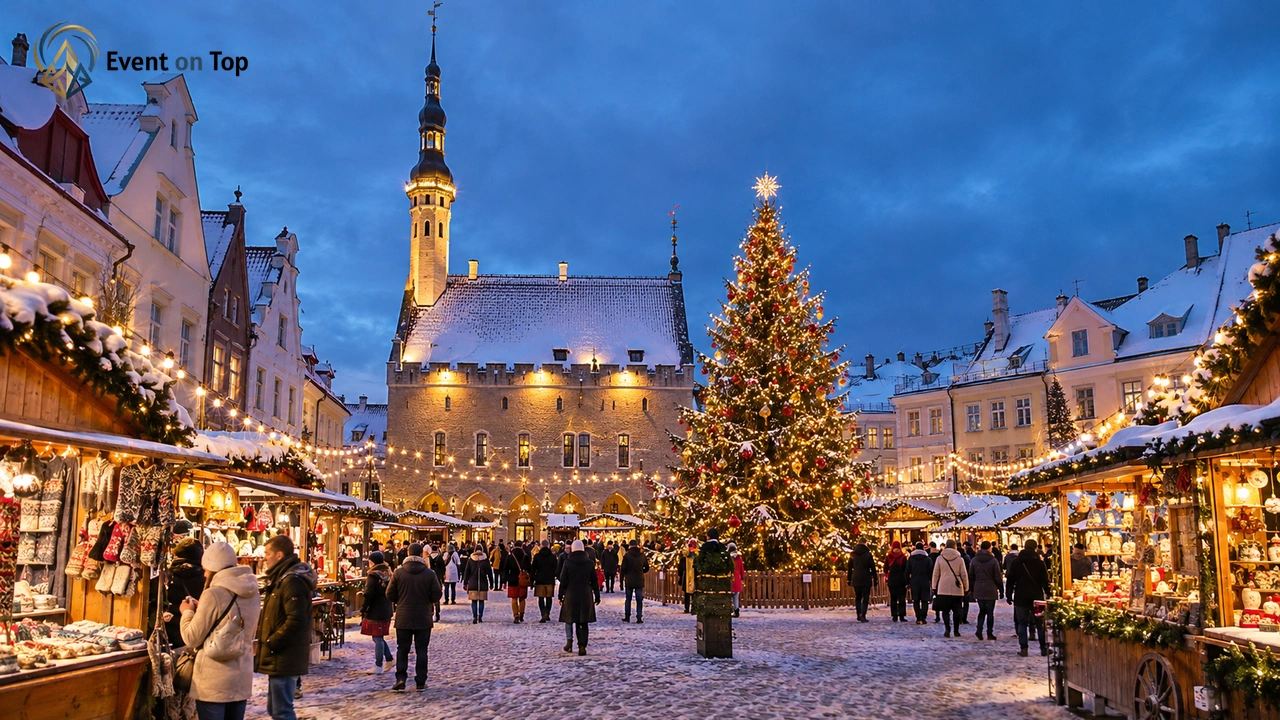
Tallinn does not have the biggest Christmas market in Europe. It has one of the oldest stories, one of the prettiest squares, and the longest season of almost any market on the continent — and that combination is exactly why it works. The Christmas market fills Town Hall Square in the middle of a walled medieval old town, under a Christmas tree that the city says has stood there since 1441. In 2026 it runs from Friday, November 20 to Wednesday, January 6, 2027 — past Christmas, past New Year, all the way to Epiphany — and it stays open on Christmas Day itself, which most European markets do not.
Go in with the right expectations and Tallinn is one of the best Christmas city breaks in Europe: a small, charming market inside a genuinely medieval old town, with an ice rink five minutes away, a ferry to Helsinki in two hours, and prices that are still gentler than Scandinavia. This is the full guide: the confirmed 2026 dates and hours, the 1441 tree story and the argument with Riga, what to eat and buy, everything worth doing beyond the market, a timed two-day plan, where to stay, and the honest warnings.
Christmas in Tallinn 2026 at a Glance
- Tallinn Christmas Market: Fri Nov 20, 2026–Wed Jan 6, 2027, on Town Hall Square (Raekoja plats) in the Old Town. Stalls daily 10:00 a.m.–8:00 p.m.; hot drinks until 10:00 p.m., 11:00 p.m. on Fridays and Saturdays. Free entry. 2026 is its 26th edition.
- Opening night: Fri Nov 20 at 6:00 p.m., with the switching on of the Christmas tree lights.
- First Sunday of Advent: Sun Nov 29 — the Mayor of Tallinn and the Dean of Tallinn Cathedral light the Advent candle on the square, and Santa’s house opens, welcoming children daily 12:00–6:00 p.m.
- The tree: first mentioned in records in 1441, put up by the Brotherhood of Blackheads. Tallinn claims it as Europe’s first public Christmas tree — 2026 is 585 years since the first mention. Riga disputes the claim.
- Open on Christmas Day: the market lists itself as open every day from Nov 20 to Jan 6, including Dec 24–26. Check the official site for any changed hours on Dec 24, 25 and 31 before you plan a late evening around them.
- The setting: Town Hall Square in front of the Gothic Town Hall, inside a UNESCO World Heritage Old Town (listed 1997). The whole old town is walkable end to end in about 15 minutes.
- Weather and light: December averages -0.9°C (daytime high +1.2°C, low -3.1°C). Daylight lasts about six hours in mid-December, with the sun setting between about 3:30 and 4:00 p.m. — which means the market lights are doing their job by mid-afternoon.
- Getting there: a two-hour ferry from Helsinki, or a flight into Tallinn Airport with trams T2 and T4 into the centre in 20–30 minutes.
The 1441 Tree: Europe’s First Christmas Tree?
The tree on Town Hall Square is the reason this market is famous beyond Estonia, and the story is worth knowing before you stand under it. Historical records in Tallinn mention a decorated tree being placed on the square as early as 1441, put up by the Brotherhood of Blackheads, the guild of unmarried merchants. On that basis Tallinn claims the first publicly displayed Christmas tree in Europe — and in 2026 it is 585 years since the first known mention of the tradition.
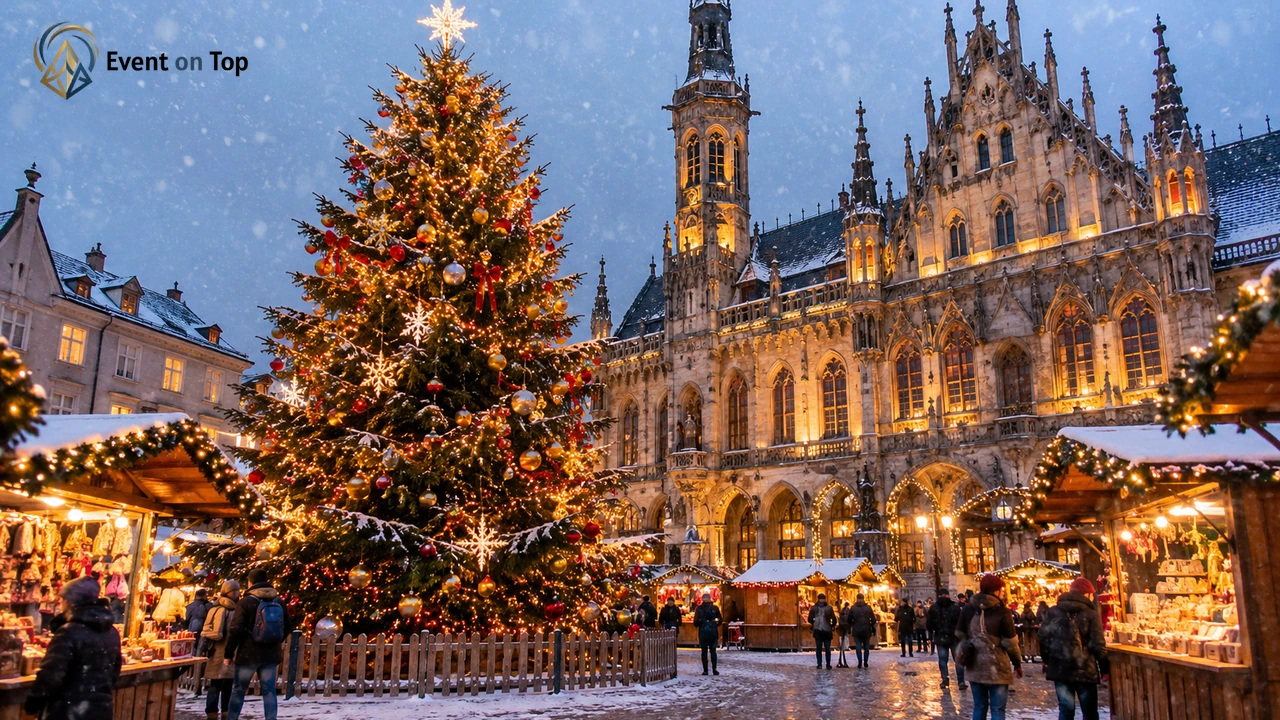
The claim is not quite that simple, and the honest version is more interesting than the slogan. Riga, the capital of Latvia, also claims the honour, pointing to its own decorated tree of 1510, marked with a plaque on its Town Hall Square. The two cities have spent years in a fairly friendly argument about it, and historians on both sides say the surviving records are too thin to settle the question either way. Read 1441 as Tallinn’s claim rather than an established fact — and enjoy the tree for what it is either way: a huge, beautifully decorated tree in the middle of a medieval square, with the Gothic Town Hall behind it and the market spread out at its feet. The opening night, when the lights are switched on at 6:00 p.m. on November 20, is the one moment of the season built around the tree itself.
The Market on Town Hall Square
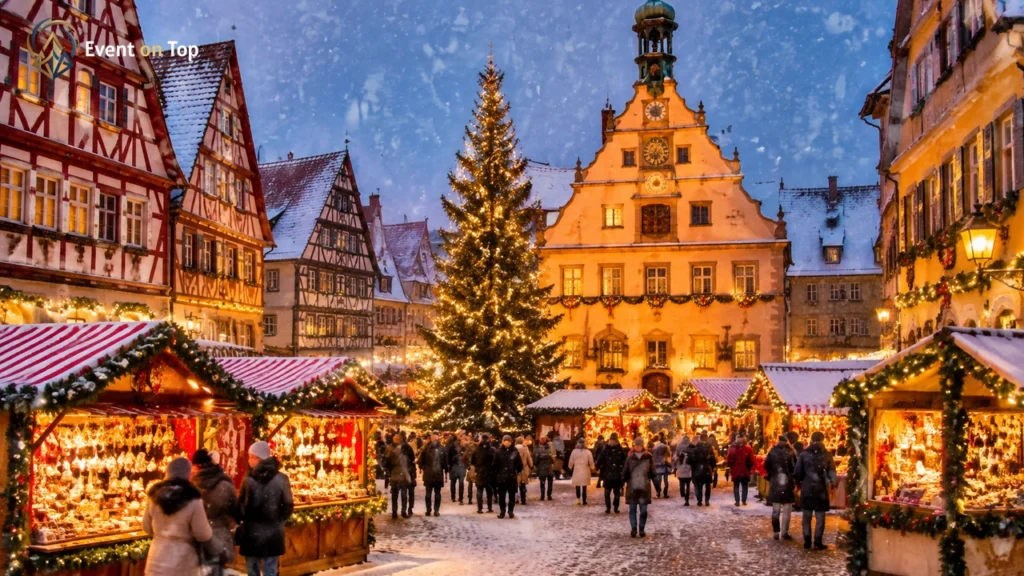
The market itself is small — a few dozen wooden stalls rather than a sprawling festival — and that is the first thing to understand about it. A large part of its charm comes from the setting rather than the size: medieval Town Hall Square, historic buildings on every side, Christmas lights, and the huge tree standing in the middle. On a snowy winter evening, the little stalls covered in lights, surrounded by medieval buildings, can look a bit like something from an elf village. Even without snow, it is still worth visiting — the square does the work.
Give the market itself one to two hours, including a slow lap and a drink. The stalls sell handicrafts, Christmas gifts, local products and food, and the programme changes through the season: concerts and folk dance groups perform on the square most evenings through December, with the schedule changing by date, so check the official programme when you plan. There are carousels for children, and Santa’s little house has a post box where children can leave their Christmas wishes. The Town Hall opens its upper floor to visitors in the season, giving you a view straight down onto the market and the tree — worth doing if the queue is short. The market draws around 200,000 visitors across its full run, so a mid-December evening is busy and a weekday morning is calm; the opening and closing weeks are noticeably quieter than the middle of December.
One practical note the local guides all make: the old town streets are paved with cobblestones, and in winter they get slippery with snow and ice. Town Hall Square itself is accessible, but allow a little extra time getting around, wear boots with real grip rather than fashion shoes, and take the same care you would anywhere in the dark. Estonia requires pedestrians to wear a reflector or another light source during the darker months — you can buy a simple reflector in supermarkets, kiosks and petrol stations for a few euros, and a handmade one makes a genuinely practical souvenir from the market.
What to Eat and Drink at the Tallinn Market
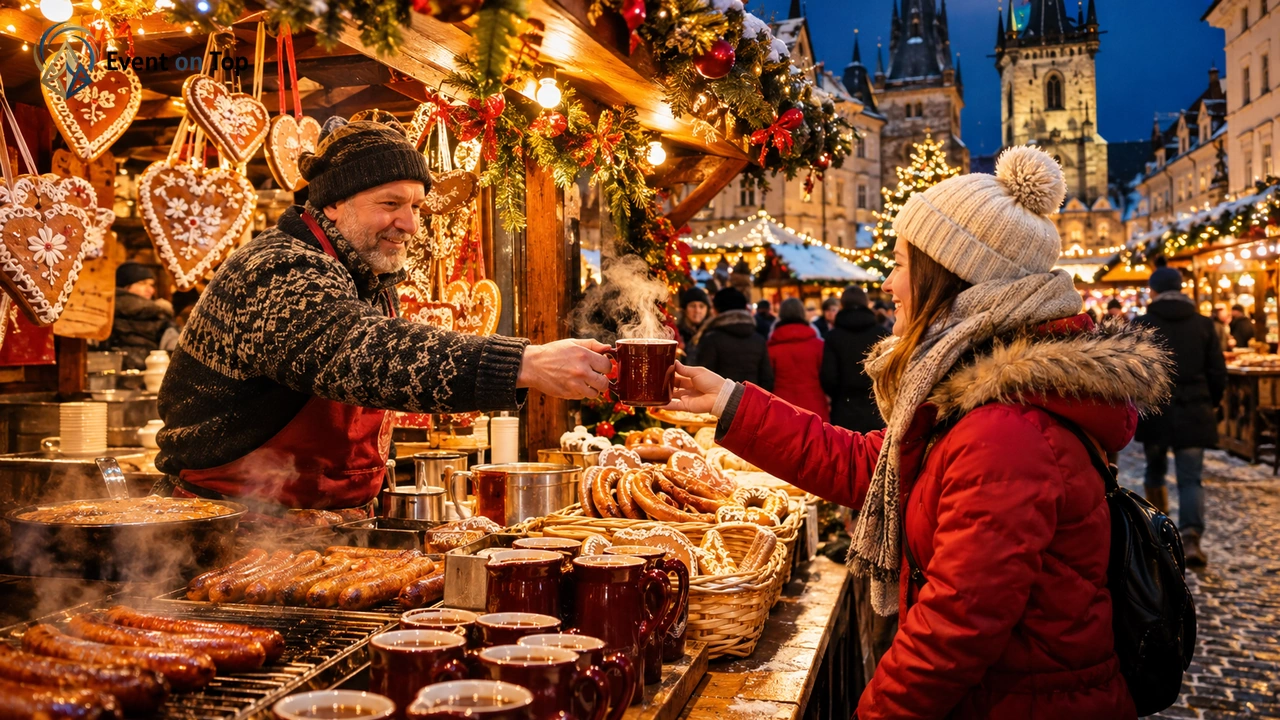
Come hungry, and start with the glögi. The Estonian mulled drink is the market’s signature: the organiser says the market offers the widest selection of glögi in Europe, served in dozens of varieties, with and without alcohol — cranberry-cherry, a raspberry-blackcurrant version from the Setomaa region, even a pumpkin variety — plus a medieval-recipe spiced wine, new this season, made to an old recipe. Buy a hot glögi first and only then start wandering around to see what the stalls have to offer. Based on 2025 prices, budget around €7–9 for a mug of glögi and around €15 and up for a more substantial hot meal; prices in 2026 may be different, and the market is not cheap — the food is worth trying for the experience, but a proper meal in the old town costs similar money.
The food stalls lean traditional rather than photogenic, which is exactly the point. Verivorst, the traditional Estonian blood sausage made with barley groats, is served sizzling hot from the grill, usually with sauerkraut (hapukapsas), roasted potatoes and lingonberry jam. Sült is jellied pork, served cold, usually with mustard. Roast pork, reindeer sausage, elk sausages, lamb chops and duck confit are carved on site. Piparkoogid — thin, crisp, heavily spiced gingerbread cookies — are sold hand-decorated at the market’s Sweet House, along with cinnamon and cardamom buns baked fresh. If blood sausage is not your idea of a good time, there are also soups, artisan breads, jams, sweets and baked goods, so trying it is not compulsory.
One thing to know before you order: at public events in Estonia, reusable cups, plates and cutlery are used to reduce single-use waste. At the market, a €2 deposit is added to your cup, plate or other reusable dishware, and you get the money back when you return it. So if your glögi costs €7, you initially pay €9 including the cup deposit, and €2 comes back when you hand the cup in. In practice, cards are taken almost everywhere at the market — Tallinn is an extremely card-friendly city — but a little cash as a backup never hurts.
What to Buy at the Tallinn Christmas Market
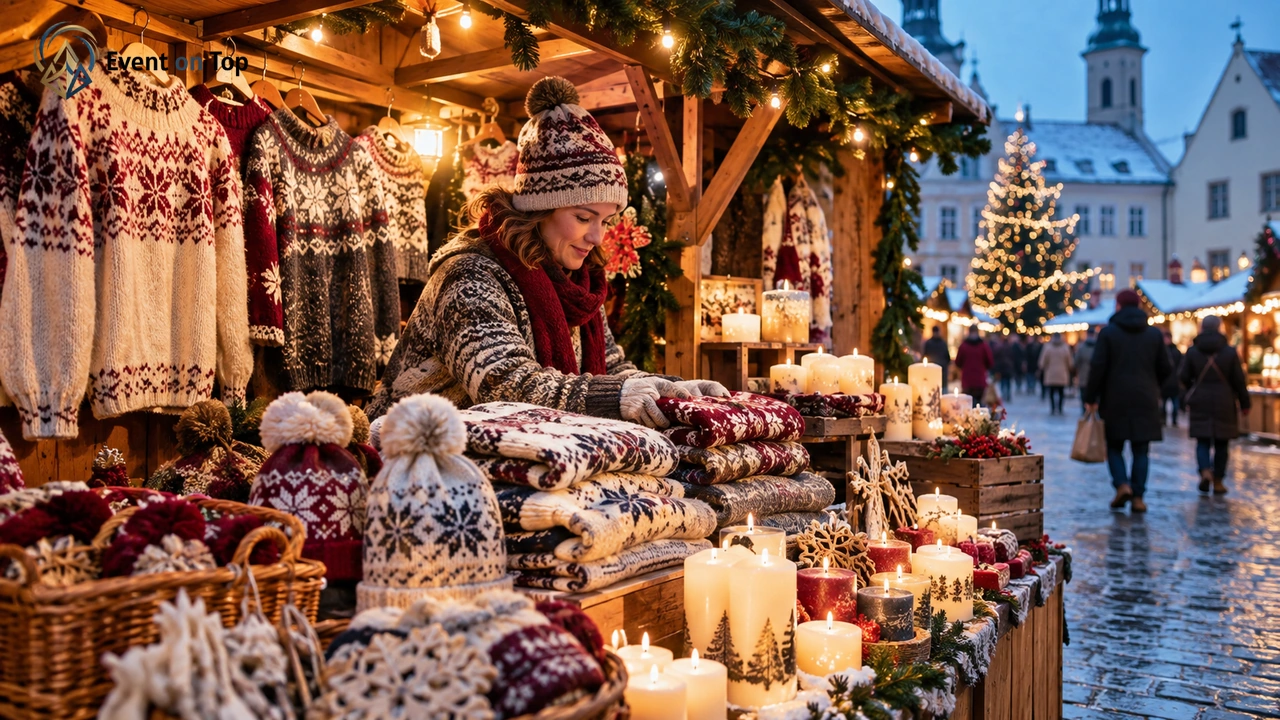
The shopping is the other reason to come, and the rule is simple: buy what is made in Estonia. The market’s 2026 focus is on local artists and craftspeople, and the best stalls are the ones where the person selling made what they are selling. Wool socks are a market speciality, including pairs made from dog and alpaca wool. Knitted sweaters and hats in Estonian patterns are the classic Tallinn souvenir. Candles in unusual shapes come from local makers. Christmas decorations, from traditional to contemporary, are on most huts. Handmade truffles and gingerbread make the easiest edible gifts to take home. Avoid the generic stalls selling the same imported baubles you could buy anywhere; the market is at its best when you buy from the makers themselves. For the wider European picture, see our guide to the best Christmas markets in Europe, and for the other great northern market city, our Christmas in Stockholm guide.
Beyond the Market: the Old Town, Toompea and the Ice Rink
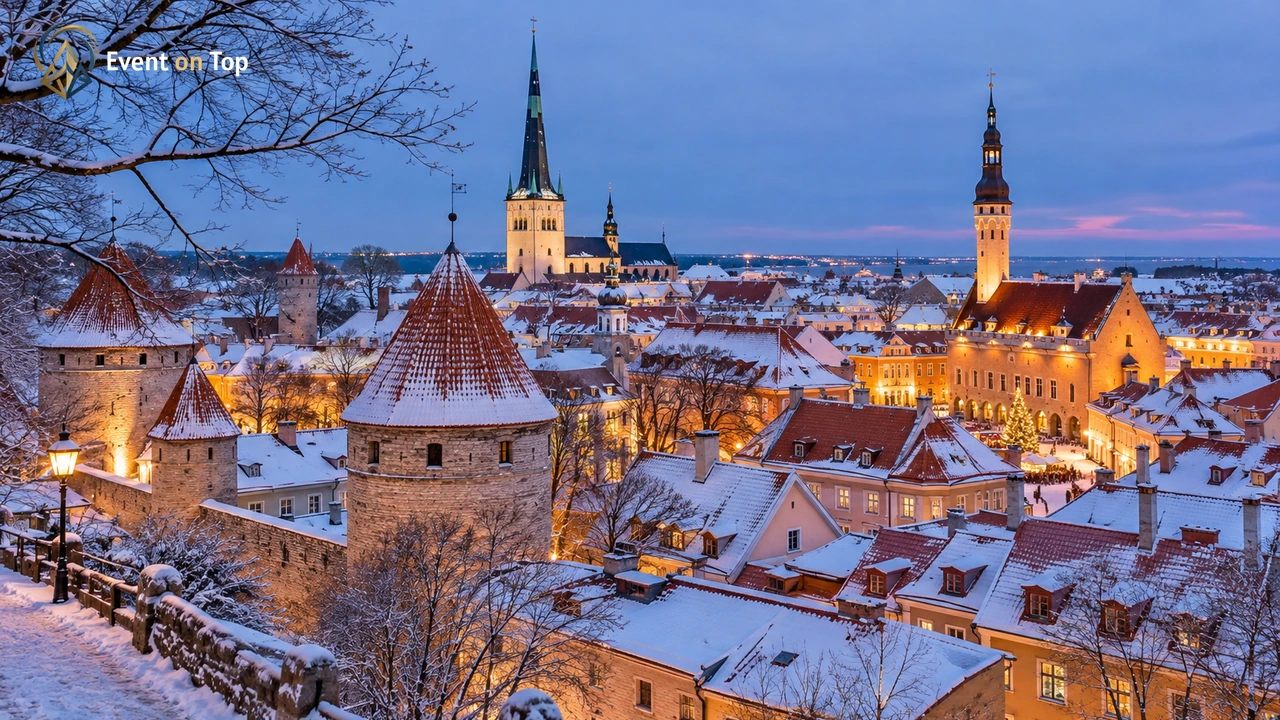
The market is the centrepiece, not the whole trip — and the local advice is blunt about it: the market alone is not worth travelling a long way for, but the market plus the Christmas-decorated old town and the rest of the city makes a lovely long winter weekend. Start with the old town itself. Walk it in the morning, while there is daylight: Viru Street from the Viru Gates to Town Hall Square, the merchant houses, the churches, and the lanes that look their best with snow and Christmas lights. Then climb Toompea, the hill above the old town, after dark — from the Kohtuotsa and Patkuli viewing platforms the market becomes a small pool of light below you, with the rest of the medieval skyline dark and quiet around it.
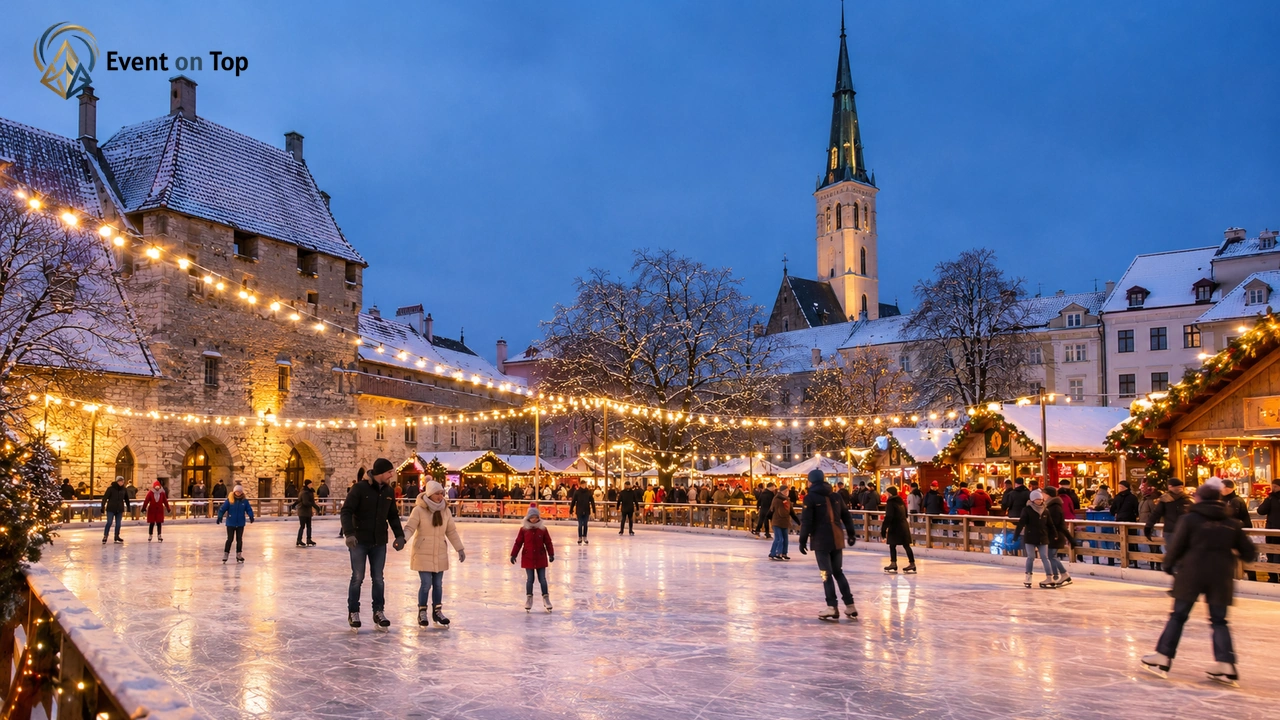
The Harju Street ice rink (Uisupark) sits five minutes’ walk from the square, next to St Nicholas’ Church, and is the easiest thing to fold into the same evening as the market. It usually opens in late November and runs through the winter, with skate hire available, and skating under the lights with the medieval spires as a backdrop is the most Tallinn thing you can do after the market itself. For a bad-weather hour, the Seaplane Harbour — the Estonian Maritime Museum in the historic seaplane hangars, home to the submarine Lembit, built in 1937 — is warm, indoors and genuinely interesting. And through December, the Christmas Jazz festival (Jõulujazz) runs concerts across the city, opening in late November — the 2026 opening night, November 30, brings the Jazz at Lincoln Center Orchestra to the Alexela Concert Hall.
Telliskivi, Kadriorg and the Rest of the City
Tallinn has a second Christmas, outside the walls. Telliskivi Creative City — a regenerated industrial district of former factories turned into boutiques, restaurants, cafés and galleries — is where the city goes when it wants something less medieval and more local, and it is worth an afternoon. The smaller Balta Christmas Market by Balti Jaam station runs the same dates as the main market, November 20 to January 6, and is a calmer, more neighbourhood-feeling alternative to the square. Kadriorg Palace and its park, a short tram ride east, make a quiet winter walk when the old town feels crowded — the palace grounds in snow are one of the city’s prettiest sights, and the area around it is calm even on a December Saturday. Pair the market with one of these and the trip stops feeling like a single square and starts feeling like a city.
And Tallinn pairs naturally with its neighbours. The ferry to Helsinki takes about two hours, which makes the city an easy addition to a Finland trip — or the other way round, a day trip from Helsinki if you are already there. Riga is about four to four and a half hours by coach, and both markets run into January, so a combined Baltic Christmas market trip works well. If you are heading further north, see our Christmas in Lapland guide and our Christmas in Oslo guide — Tallinn is the gentler entry point into a Nordic winter, with December temperatures around freezing rather than the deep cold of Lapland.
The Two-Day Plan
Day one is the market and the old town. Arrive by mid-morning, walk Viru Street from the Viru Gates to Town Hall Square, and do a first lap of the market while it is calm — the stalls open at 10:00 a.m. Buy your glögi, try the verivorst, and pick up the wool socks and gingerbread early, before the best stalls sell out of the good stuff. In the afternoon, climb to Toompea for the viewpoints, then skate at the Harju Street rink as the light goes. Come back to the square after dark, when the lights are at their best, and finish with a hot drink from the stalls that stay open until 10:00 or 11:00 p.m.
Day two is the rest of the city. Start at the Seaplane Harbour in the morning, then walk to Telliskivi for lunch and the Balta market, and finish in Kadriorg for a quiet winter walk before returning to the old town for a final evening at the market. If your dates line up with the first Sunday of Advent, November 29, be on the square for the Advent candle lighting; if they line up with the opening night, November 20, be there at 6:00 p.m. for the tree lights. Two days is enough for the old town and the market; a third day leaves time for a trip across the water to Helsinki or for the districts outside the walls.
Where to Stay, Getting There and Practical Tips
Stay inside the Old Town walls if you can — Town Hall Square is a few minutes’ walk from almost every hotel there, and that is the whole point of Tallinn at Christmas. December weekends fill up early, so book ahead. If the old town is full or over budget, the Rotermann Quarter, between the old town and the sea, is quieter and often better value for the same December week, and still a short walk from the square.
Getting there is easy. Tallinn Airport is very close to the city centre: trams T2 and T4 both run from the airport towards central Tallinn, and the journey takes roughly 20–30 minutes — T2 to Mere puiestee, then walk through the Viru Gates and along Viru Street, or T4 to Viru, with the old town right in front of you. A taxi from the airport is simple too — order through the Bolt app so you see the price before confirming, and ask to be dropped near an old town entrance, since the square itself is pedestrianised. From Helsinki, Tallink and Viking Line both run the crossing in around two to two and a half hours, with several sailings a day even in winter; from Terminal D it is about 1.5–1.7 km to the square, roughly 20–25 minutes on foot. Once you are there, you do not need a car at all — the old town, Rotermann, Kalamaja and Kadriorg are all reachable on foot or by tram, and a one-hour public transport ticket costs €2, paid by tapping a contactless bank card on the validator, with spending capped at the €5.50 day ticket price.
Dress for standing outside in real Baltic cold. December in Tallinn averages -0.9°C, with daytime highs around +1.2°C and lows around -3.1°C, but those averages hide the range: you might get rain and temperatures above freezing, or deep snow and well below freezing, sometimes in the same trip. Pack warm boots with grip for the icy cobbles, layers, gloves and a hat, and a reflector — pedestrians are required to wear one in the dark months. Bring cash as well as a card. And check the official sites the week you travel — christmasmarket.ee and visittallinn.ee — because dates, hours and prices can change, and the exact hours for Christmas Eve, Christmas Day and New Year’s Eve are not published in detail.
The Honest Bit
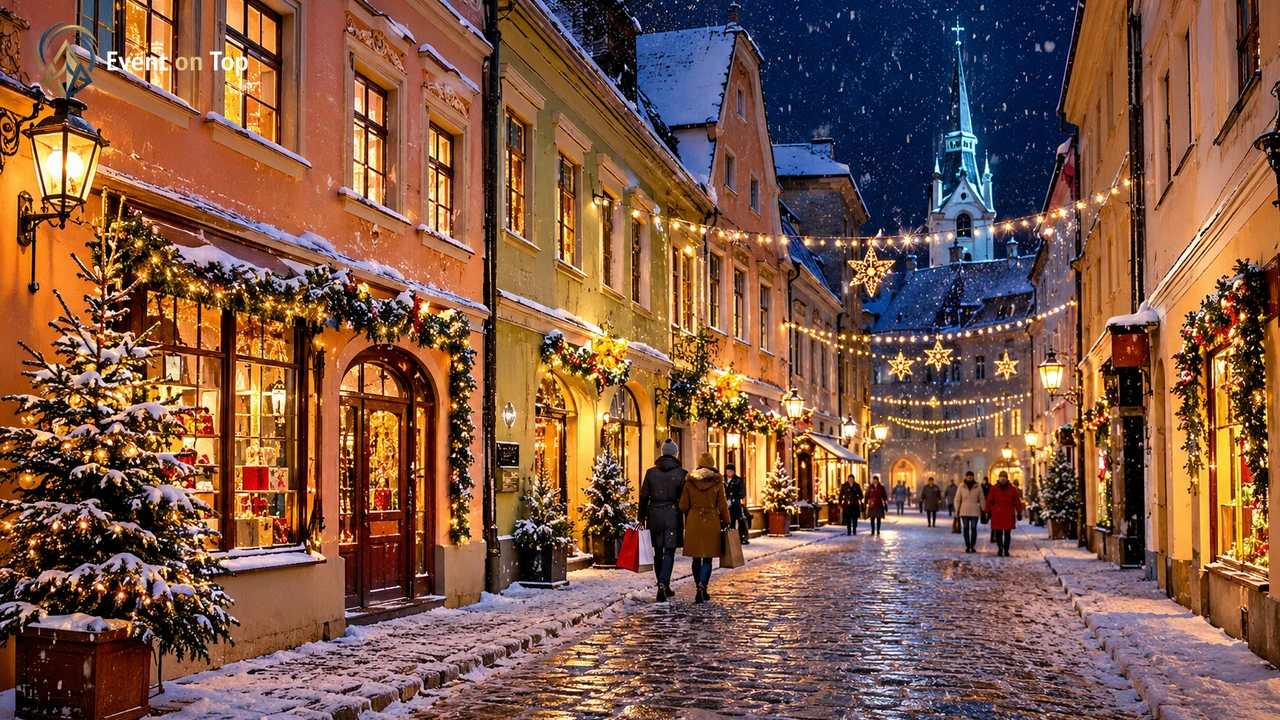
Tallinn is quieter than Vienna and smaller than Nuremberg, and that is its charm — but go in with your eyes open. The honest warning is the size: the market is a few dozen stalls on one square, and if you arrive expecting a sprawling festival, you will be disappointed. The trip works because the market sits inside a walled medieval old town that is beautiful in its own right, with the ice rink, the viewpoints, Telliskivi and Kadriorg around it. Christmas Day itself is very quiet — Christmas is mainly celebrated on December 24 in Estonia, many Estonians spend that day at home with their families, and December 24–26 are public holidays, so many shops and restaurants close. Come on a Saturday evening in mid-December and the square is a crush; come on a weekday morning and it is a different, calmer place. And the cold is real: six hours of daylight, icy cobbles, and weather that can swing from rain to deep snow in a day. Pack for it, plan around the dark, and Tallinn at Christmas is one of the best small winter breaks in Europe.
Christmas in Tallinn 2026: FAQs
When is the Tallinn Christmas Market in 2026?
The Tallinn Christmas Market runs Friday, November 20, 2026 to Wednesday, January 6, 2027, on Town Hall Square (Raekoja plats) in the medieval Old Town. Stalls are open daily 10:00 a.m.–8:00 p.m., and hot drinks are served until 10:00 p.m., or 11:00 p.m. on Fridays and Saturdays. Entry is free. The market opens at 6:00 p.m. on November 20 with the switching on of the Christmas tree lights.
Is the Tallinn Christmas Market open on Christmas Day?
Yes — the market lists itself as open every day from November 20, 2026 to January 6, 2027, including Christmas Day, which makes it one of the few European Christmas markets open over Christmas, New Year and the first week of January. December 24–26 are public holidays in Estonia, so many shops and restaurants around the square close, and the exact hours for Christmas Eve, Christmas Day and New Year’s Eve are not published in detail — check the official site before you plan a late evening around them.
Does Tallinn have the first Christmas tree in Europe?
Tallinn claims the first public Christmas tree in Europe, raised on Town Hall Square in 1441 by the Brotherhood of Blackheads, the guild of unmarried merchants. Riga disputes the claim, pointing to its own decorated tree of 1510. Historians on both sides say the surviving records are too thin to settle the question, so read 1441 as Tallinn’s claim rather than an established fact — 2026 is 585 years since the first known mention of the tradition.
How many days do I need in Tallinn at Christmas?
One full day covers the market and the closest sights if you follow a plan — the market, the old town walk, Toompea after dark and the Harju Street ice rink. Two days is better: it lets you see Telliskivi and Kadriorg, visit the Seaplane Harbour, and enjoy the market at a weekday-morning pace instead of rushing it. A third day leaves time for a trip across the water to Helsinki.
What should I eat at the Tallinn Christmas Market?
Start with glögi, the Estonian mulled wine — the market claims the widest selection in Europe, in dozens of varieties with and without alcohol. Then try verivorst (blood sausage with sauerkraut), sült (jellied pork), piparkoogid (thin crisp gingerbread) and the cinnamon and cardamom buns from the Sweet House. Based on 2025 prices, budget around €7–9 for a mug of glögi and around €15 and up for a hot meal, plus a €2 deposit on the reusable cup, refunded when you return it.
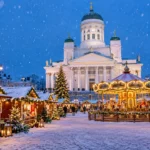
Christmas in Helsinki 2026: Market Dates, Lucia Day & Lux Helsinki
08th Nov 2026[…] Christmas in Tallinn 2026: the 1441 Tree, Town Hall Square […]