




Christmas in Dresden 2026: Striezelmarkt, the 592nd Market & the Honest Guide

Dresden does not have a Christmas market. It has five of them, all within walking distance of each other, in one of the most beautiful old towns in Germany — and the main one has been running, in one form or another, since 1434. The Striezelmarkt on the Altmarkt is Germany’s oldest Christmas market, and 2026 is its 592nd edition. It opens on Wednesday, November 25 and closes at 2 p.m. on Christmas Eve, December 24.
What makes Dresden different from the other famous German market cities is the setting. The stalls sit between the rebuilt Frauenkirche, the Zwinger palace and the Royal Palace, on squares that were rubble eighty years ago and are now among the most photographed in Europe. The market is not a theme park version of Christmas — it is a Saxon tradition with its own cake, its own prune-man mascot, its own medieval market and its own giant wooden pyramid. This is the full guide: the confirmed 2026 dates and hours for all five markets, the Stollenfest, what to eat and buy, a timed one-day plan, where to stay, and the honest warnings.

Christmas in Dresden 2026 at a Glance
- Striezelmarkt (Altmarkt): Nov 25–Dec 24. Opening day Nov 25, 4–9 p.m.; Nov 26–Dec 23 daily 10 a.m.–9 p.m.; Dec 24, 10 a.m.–2 p.m. Free entry. Germany’s oldest Christmas market, first documented in 1434; 2026 is the 592nd edition, with more than 200 traders.
- Advent auf dem Neumarkt (Frauenkirche): Nov 25, 2026–Jan 3, 2027. Opening day 5–10 p.m.; Nov 26–Dec 23, 11 a.m.–10 p.m.; closed Dec 24–26 and Jan 1; reopens Dec 27–30 and Jan 2–3. Free entry.
- Stallhof Medieval Christmas (Royal Palace courtyard): Nov 25–Dec 23, daily 11 a.m.–9:30 p.m., plus Rauhnächte Dec 27–30 and Jan 2–6. Admission €5 adults / €3 children on Advent weekends and during Rauhnächte; free on weekdays.
- Augustusmarkt (Hauptstraße, Neustadt): Nov 25, 2026–Jan 3, 2027, across the Elbe from the old town.
- Dresdner Winterlichter (Prager Straße): Nov 25–Dec 23.
- Stollenfest: Saturday, Dec 5 — a parade with a giant Stollen through the old town at around 11 a.m., cut shortly after noon.
- The one date that matters most: the Striezelmarkt closes at 2 p.m. on Dec 24 and does not reopen. Neumarkt and Augustusmarkt carry on to Jan 3, so a post-Christmas visit still works.
- Getting there: about two hours by train from Berlin, and an easy train ride from Prague. The old town is compact — all five markets are on foot.
Why Dresden’s Market Is the Oldest in Germany
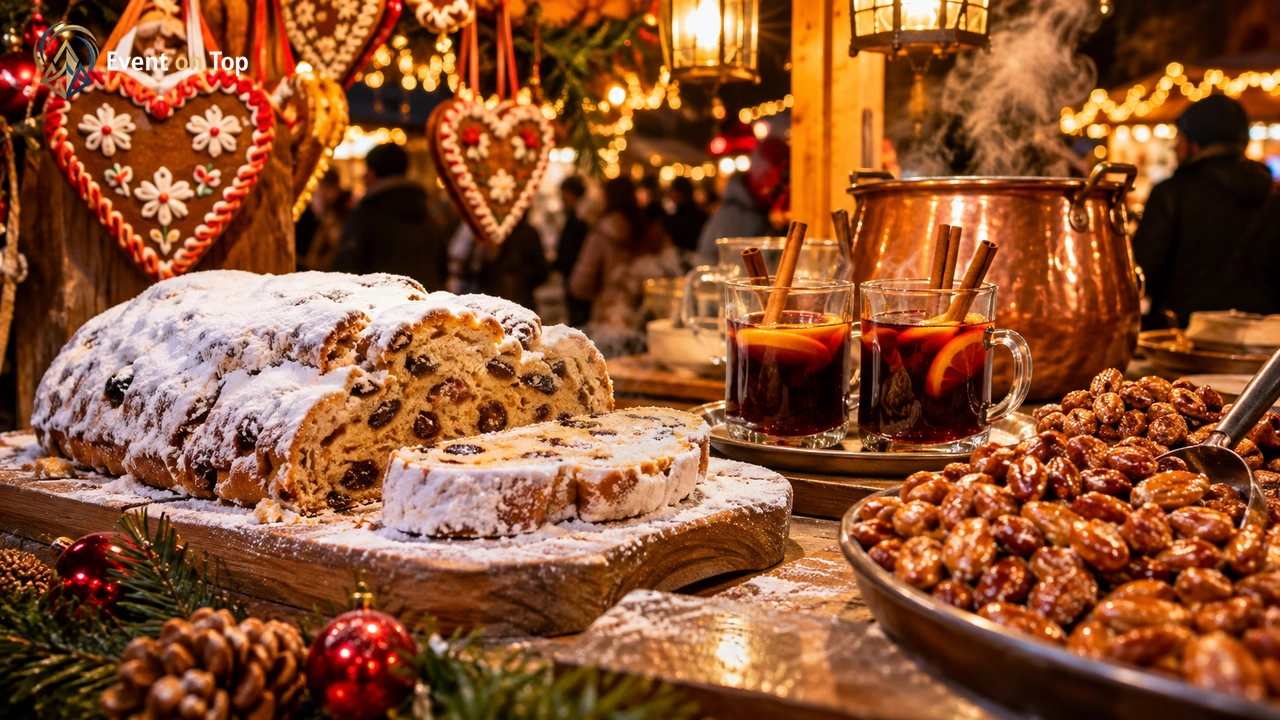
The Striezelmarkt takes its name from the “Striezel”, the old Saxon word for the Stollen loaf — the market was, from the start, a market for the Christmas cake. The first record of it dates to 1434, when it was a one-day market on the Altmarkt selling meat for the Christmas feast. Over nearly six centuries it grew into the big Advent market it is today, and the city now bills it as Germany’s oldest Christmas market. The name stuck even as the market changed: the Striezel became the Dresdner Christstollen, the cake Dresden is still famous for, and the market became the place to buy it.
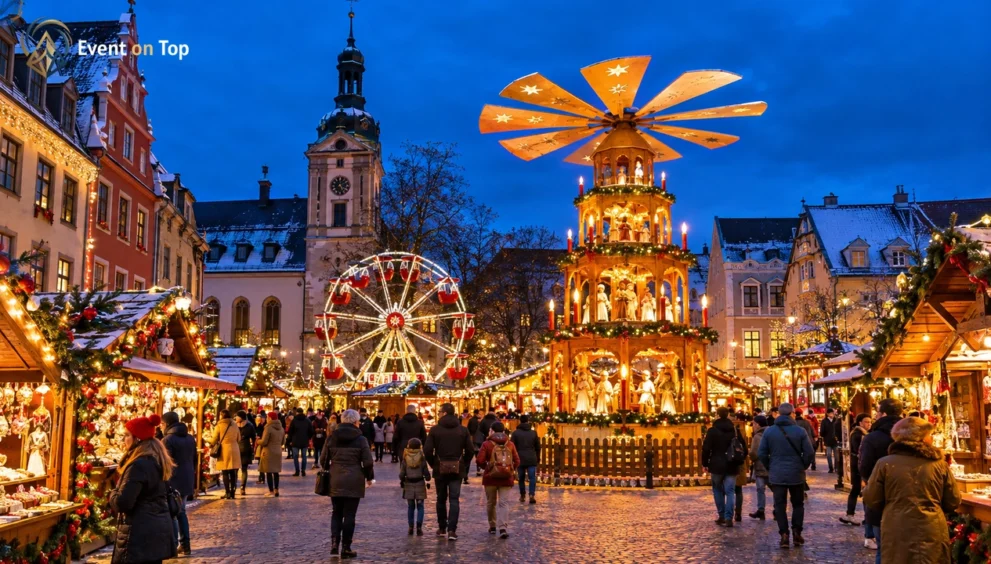
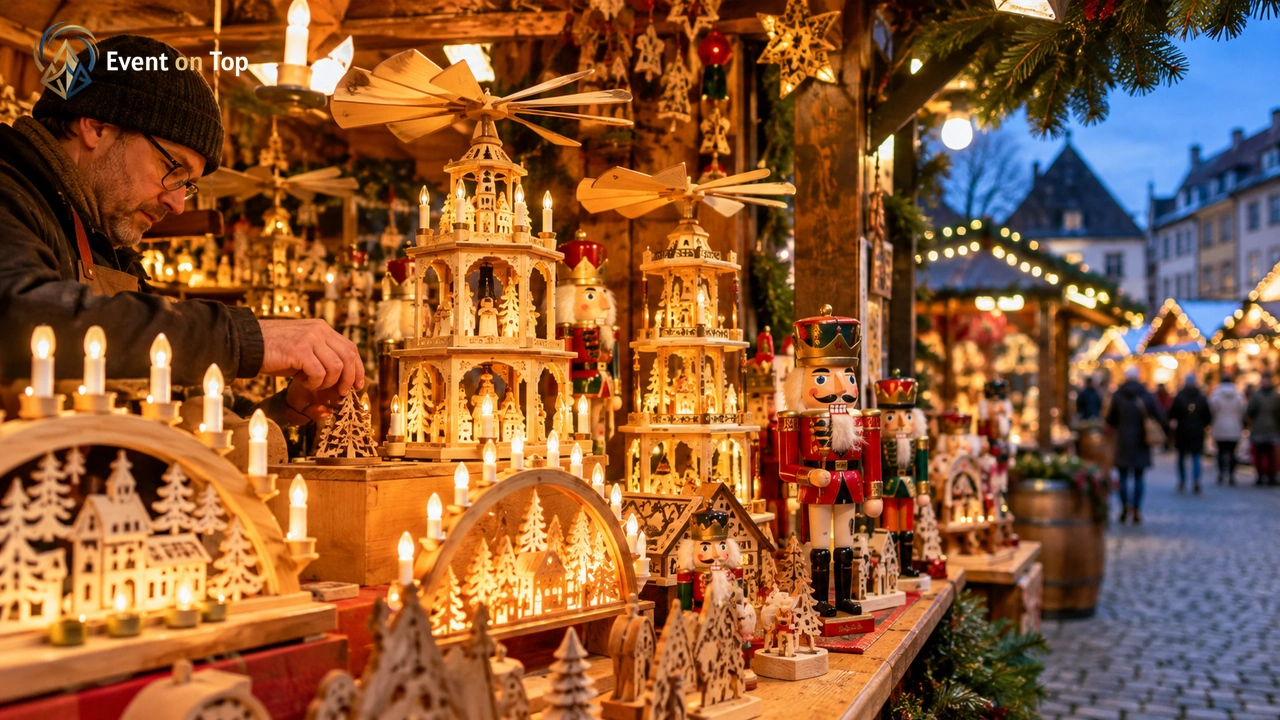
The market’s symbols are Saxon through and through. The official site lists the superlatives proudly: the world’s largest Erzgebirge step pyramid, 14.61 metres high, turning slowly over the stalls; the world’s largest walk-in Schwibbogen, the wooden candle arch from the Ore Mountains; an XXL nativity scene under the market Christmas tree; and a historic Ferris wheel that gives you the market from above, with the smell of roasted almonds and mulled wine drifting up. The most popular souvenir is the Pflaumentoffel, a little prune man — an edible figure made of prunes, considered a lucky charm and the typical symbol of Christmas in Dresden. If you buy one thing that is not food, make it a piece of Ore Mountains woodcraft: pyramids, candle arches, nutcrackers and incense smokers made in the Erzgebirge villages south of the city. For the wider German picture, see our guide to the best Christmas markets in Europe, and for the other great German market city, our Nuremberg Christkindlesmarkt guide.

The Striezelmarkt: the Main Market on the Altmarkt
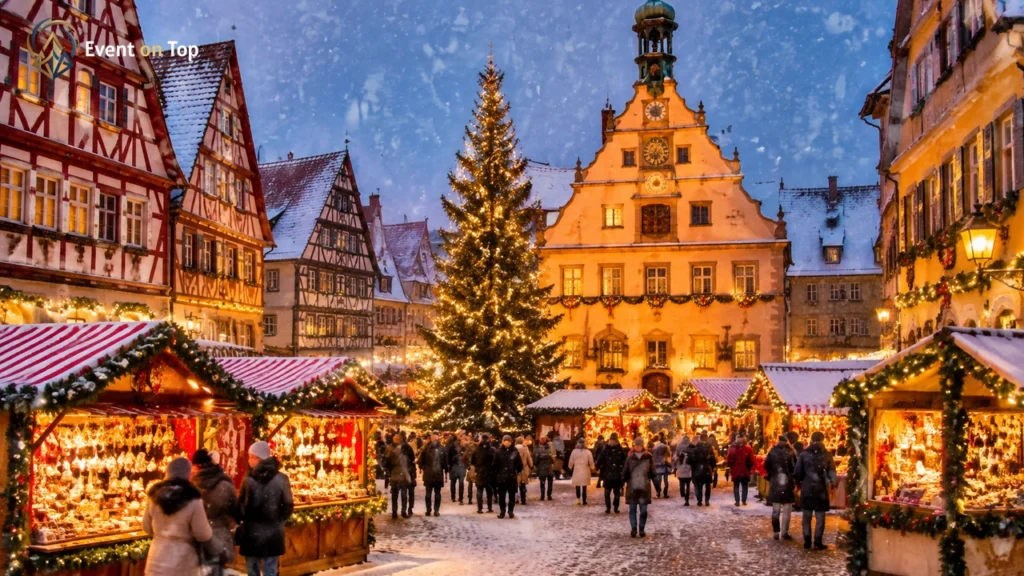
The Striezelmarkt fills the Altmarkt, the old town’s main square, opposite the Kulturpalast on Wilsdruffer Straße. It is the market everyone means when they say “Dresden Christmas market”, and it is free to enter. More than 200 traders fill the square with wooden huts, and the city runs a daily Christmas cultural programme on the market stage — music, choirs and children’s events, free to watch.
Come in the late afternoon, when the lights come on and the pyramid turns. The square is at its best between 4 and 7 p.m., before the evening crowds peak. The opening day, Wednesday November 25, starts late — 4 to 9 p.m. — so do not plan a morning visit that day. From November 26 it runs daily 10 a.m. to 9 p.m., and on Christmas Eve it opens at 10 a.m. and shuts at 2 p.m. After that, it is done: the Striezelmarkt does not reopen on Christmas Day or after. Give it two to three hours, including the Ferris wheel and a slow lap of the stalls. The themed houses — small huts dedicated to a single craft or tradition — are worth seeking out; they are what separate this market from a row of identical gift stalls.
The Other Four Markets: Neumarkt, Stallhof, Augustusmarkt, Winterlichter
Dresden’s real advantage is that the other markets are not copies of the first. Each has its own character, and all of them are a five-to-eight-minute walk from each other in the old town, except the Augustusmarkt across the river.
Advent auf dem Neumarkt is the romantic one. It sits directly in front of the Frauenkirche, the great domed church destroyed in the February 1945 bombing and rebuilt from the rubble, reconsecrated in 2005. The stalls are styled after old guild traditions — handmade pottery, Ore Mountains woodcraft, things made by the person selling them. It runs the longest of any Dresden market, to January 3, with a closure from December 24 to 26 and on January 1, and it reopens for December 27 to 30 and January 2 to 3. On New Year’s Eve it stays open from 1 p.m. to 12:30 a.m., which makes it the place to be if you are in Dresden for the turn of the year.
The Stallhof Medieval Christmas is the odd one out, and the most fun. It fills the Stallhof, the stable courtyard of the Royal Palace, right behind the Fürstenzug — the 102-metre Procession of Princes mural, made of around 24,000 Meissen porcelain tiles. Inside it is jugglers, musicians, fire pits and craftspeople in medieval dress, with wooden hot tubs you can soak in while the market goes on around you (book ahead — they are in high demand). It runs November 25 to December 23, daily 11 a.m. to 9:30 p.m., then returns for the Rauhnächte, December 27 to 30 and January 2 to 6. It is the only Dresden market that charges admission: €5 for adults and €3 for children on Advent weekends and during the Rauhnächte; on weekdays entry is free.
Across the Elbe in Neustadt, the Augustusmarkt runs along Hauptstraße from November 25 to January 3. It is the local-feeling one — longer, calmer, with a big Ferris wheel of its own and a view back across the river to the old town skyline that is worth the walk alone. The Dresdner Winterlichter on Prager Straße, the shopping street south of the Altmarkt, runs November 25 to December 23 and is best after dark, when the light installations come on. See also our guides to Christmas in Munich and Christmas in Berlin if you are planning a multi-city German Christmas trip.

Stollenfest: Saturday, December 5
If you can choose one day, choose Saturday, December 5. That is the Stollenfest, Dresden’s celebration of its famous Christmas cake. A parade carries a giant Stollen through the old town at around 11 a.m., and the cake is cut shortly after noon — with slices handed out to the crowd. It is organised by the Dresdner Stollen bakers, the association that protects the original recipe, and it is the most Dresden-specific event of the whole season: no other German market city has anything quite like it.
The Stollen itself is worth understanding before you buy one. The Dresdner Christstollen is a rich fruit loaf, dusted thick with powdered sugar, and the genuine article carries the association’s seal. You will see Stollen everywhere in December — in the market, in the bakeries on Prager Straße and in the shops around the Neumarkt — but the market stalls are where you can taste before you buy, and where the bakers will tell you how long a loaf keeps (weeks, wrapped well) and how to serve it (thin slices, with coffee, never straight from the fridge).
What to Eat and Buy at the Dresden Markets
Come hungry. The food runs Saxon: bratwurst from the grill, glühwein by the mug (keep the mug — the deposit mugs are collectable and make a better souvenir than most of the ornaments), roasted almonds, and quarkkeulchen, the Saxon quark potato pancakes served with apple sauce. The Pulsnitzer Pfefferkuchen, the spiced gingerbread from Pulsnitz just outside Dresden, is the other local sweet worth seeking out — it comes in soft and crisp versions, filled and plain, and the market stalls sell it by the piece so you can try before committing to a box.
For shopping, the rule is simple: buy what is made in Saxony. Ore Mountains woodcraft — pyramids, Schwibbögen, nutcrackers, incense smokers — is the real thing here, made in the Erzgebirge villages, and the Neumarkt stalls are the best place to find the makers themselves. The Pflaumentoffel prune man is the classic small gift: cheap, edible, lucky, and unmistakably Dresden. Christmas pyramids and candle arches are beautiful and bulky; if you buy one, ask the stall to pack it for the journey home — most do, and it is worth the ask. Avoid the generic stalls selling the same imported baubles you could buy anywhere; Dresden’s markets are at their best when you buy from the people who made what they are selling.
Beyond the Markets: the Frauenkirche, the Zwinger and the Elbe
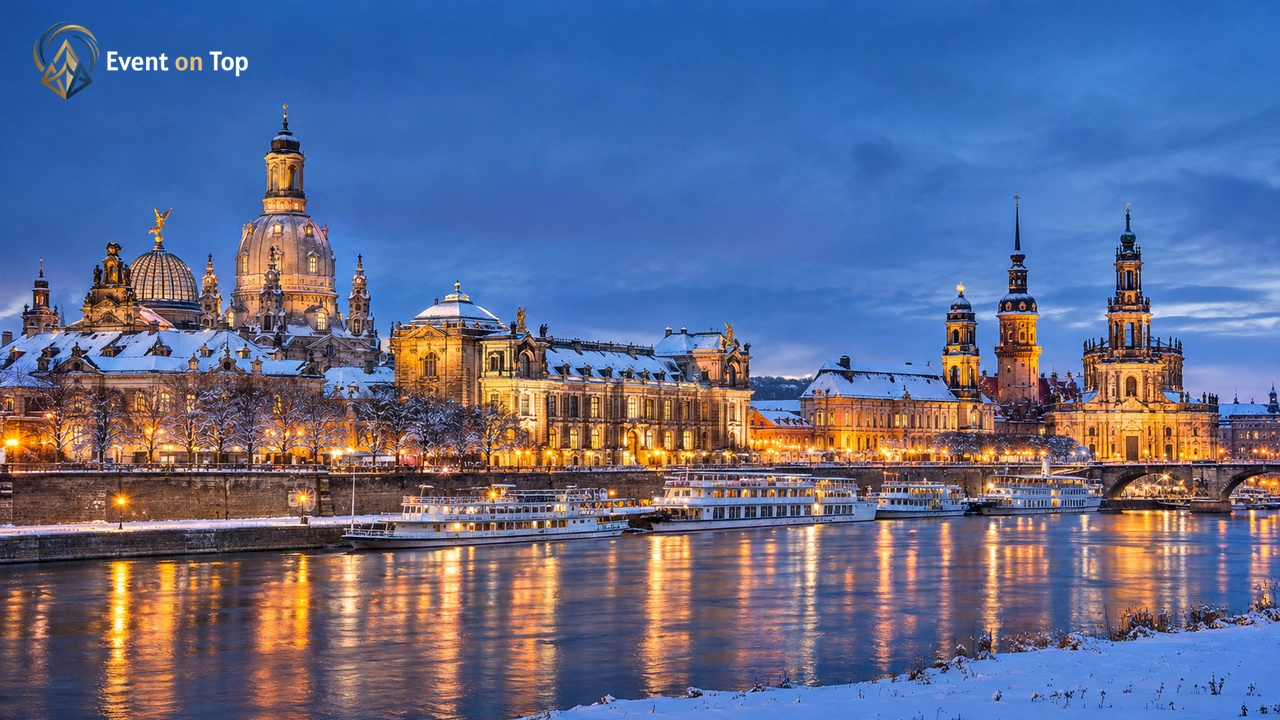
Dresden rewards you for looking up from the stalls. The Frauenkirche, the dome that defines the skyline, is free to enter, and its story — destroyed in February 1945, rebuilt stone by stone from the rubble, reconsecrated in 2005 — is written into the building itself: the dark, fire-blackened original stones stand out against the pale new ones. Climb the dome for the view over the old town and the Elbe if the weather is clear; the market squares look small and perfect from up there.
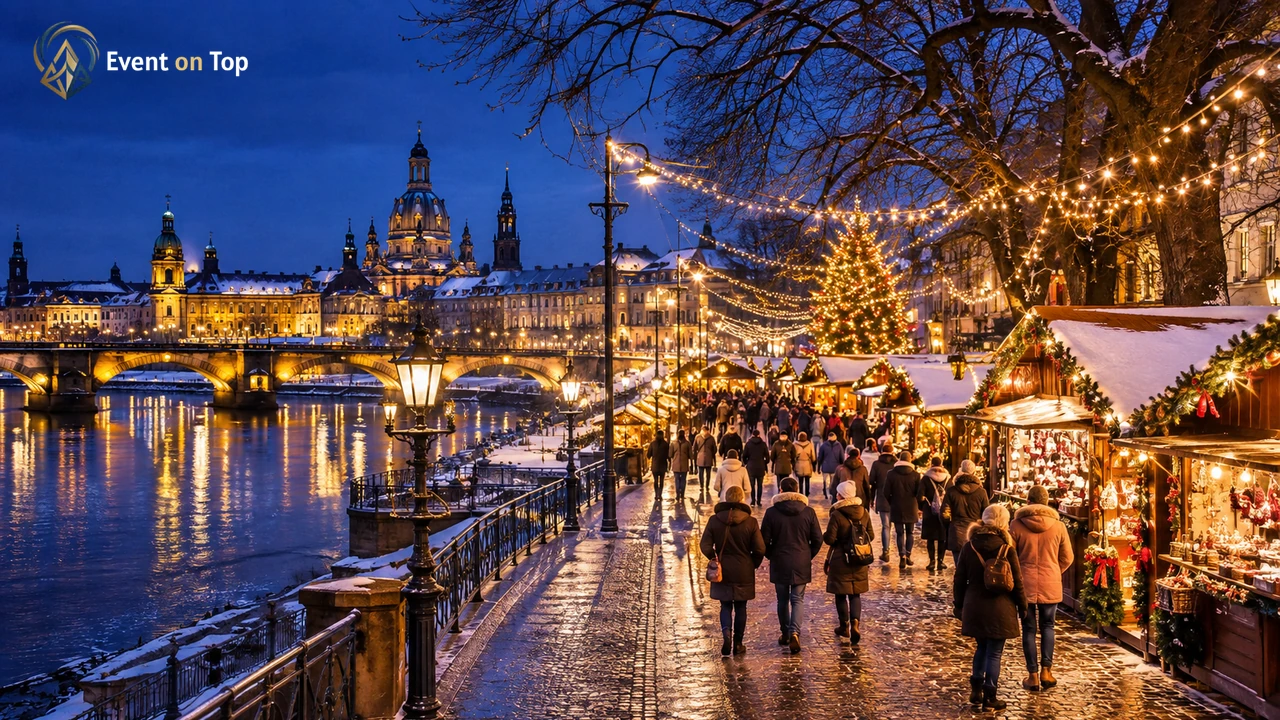
Next door, the Zwinger palace and the Semperoper opera house frame the Theaterplatz, and the Royal Palace — home of the Green Vault treasure collection — backs onto the Stallhof market. The Fürstenzug mural on the Stallhof wall is worth five minutes on its own: 102 metres of Saxon rulers in Meissen porcelain. And when the markets close for the evening, walk to the Elbe. The riverbank at dusk, with the old town lit up across the water, is one of the great free sights of a German Christmas — and the walk across the Augustusbrücke to the Neustadt side gives you the postcard view of the Frauenkirche dome, the Hofkirche and the palace rooftops in a single frame.
The One-Day Plan
Start at the Striezelmarkt when it opens at 10 a.m., while the square is calm. Do a full lap, ride the Ferris wheel for the view, and pick up your Stollen and Pflaumentoffel early — the best stalls sell out of the good stuff by the afternoon. Then walk the five minutes to the Neumarkt for the Frauenkirche market: this is the place to browse slowly, talk to the makers, and buy the woodcraft. Step inside the Frauenkirche while you are there.
After lunch — bratwurst and quarkkeulchen at the market, or a sit-down break in one of the cafés on the Neumarkt — head to the Stallhof for the medieval market in the afternoon, when the fire pits and torches look their best. Cross the Augustusbrücke to the Augustusmarkt in Neustadt for the late afternoon, then walk back across the river as the lights come on: the old town from the bridge at dusk is the photograph of the trip. Finish the evening back at the Striezelmarkt for glühwein under the pyramid, and if you are still going, the Winterlichter on Prager Straße on the way home.
Where to Stay, Getting There and Practical Tips
Stay in the Altstadt, within walking distance of the Altmarkt and the Neumarkt — that is the whole point of Dresden at Christmas, and the old town is compact enough that everywhere central is a ten-minute walk from a market. Two well-known options put you right in it: the Hotel Taschenbergpalais Kempinski, in the Taschenbergpalais beside the Royal Palace, and the NH Collection Dresden Altmarkt, on the Altmarkt itself. Both are popular for December weekends, so book early; if they are full, anywhere around Prager Straße or the Neumarkt keeps you within a short walk.
Dresden is about two hours by train from Berlin, and an easy train ride from Prague, which makes it a natural stop on a German Christmas trip — pair it with Nuremberg or Munich by train, or with Berlin for a long weekend. Once you are there, you do not need transport in the old town: everything in this guide is on foot, and the Augustusmarkt is a fifteen-minute walk across the river. Dress for standing outside — the markets are open-air, December in Saxony is cold, and the glühwein only warms you for so long. Bring cash as well as a card: most stalls take cards now, but the smaller craft stalls and the medieval market are easier with euros in hand. And check the official sites the week you travel, because dates, hours and ticket prices can change.
The Honest Bit
Dresden is quieter than Nuremberg and less polished than Munich, and that is its charm — but go in with your eyes open. The honest warning is the calendar: the Striezelmarkt closes at 2 p.m. on Christmas Eve and does not reopen, so if you arrive in Christmas week expecting the main market, you will find a quiet, beautiful old town with the Neumarkt and Augustusmarkt still running to January 3, the churches open, and the lights on — but no Striezelmarkt. Christmas Day itself is very quiet. Come on a Saturday in December and the Altmarkt is a crush; come on a weekday morning and it is a different, calmer place. The Stallhof is the one market that charges, and only at weekends — go on a weekday and it is free. And the Stollenfest on December 5 is wonderful and very crowded: arrive for the parade early, or watch it from the edges and cut through to the stalls after the cake is cut.
Christmas in Dresden 2026: FAQs
When is the Dresden Striezelmarkt in 2026?
The 592nd Dresdner Striezelmarkt runs November 25 to December 24, 2026, on the Altmarkt. Opening day, November 25, runs 4–9 p.m.; November 26 to December 23 it is open daily 10 a.m.–9 p.m.; on Christmas Eve, December 24, it opens 10 a.m. and closes at 2 p.m. Entry is free.
Is the Dresden Christmas market the oldest in Germany?
Yes — the Striezelmarkt was first documented in 1434, which makes it Germany’s oldest Christmas market, and the city bills the 2026 edition as its 592nd. It is named after the “Striezel”, the old Saxon word for the Stollen loaf.
What is the Stollenfest in Dresden?
The Stollenfest is Dresden’s celebration of its famous Christmas cake, held on Saturday, December 5, 2026. A parade carries a giant Stollen through the old town at around 11 a.m., and the cake is cut shortly after noon, with slices handed out to the crowd.
Which Dresden Christmas markets stay open after Christmas?
Advent auf dem Neumarkt and the Augustusmarkt both run to January 3, 2027 (Neumarkt is closed December 24–26 and January 1, and reopens December 27–30 and January 2–3). The Stallhof medieval market returns for the Rauhnächte, December 27–30 and January 2–6. The Striezelmarkt itself closes at 2 p.m. on December 24 and does not reopen.
How many days do I need in Dresden at Christmas?
One full day covers all five markets and the main sights if you follow a plan — start at the Striezelmarkt, walk to the Neumarkt and the Stallhof, cross to the Augustusmarkt, and finish back at the Altmarkt after dark. Two days is better: it lets you see the Frauenkirche dome and the Zwinger properly, go to the Stollenfest if your dates line up, and enjoy the markets at a weekday-morning pace instead of rushing them.