






Oktoberfest 2027 Munich: Dates, Costs & Tips

Oktoberfest 2027 takes place in Munich, Germany from Saturday 18 September to Sunday 3 October 2027 — sixteen days on the Theresienwiese, the open fairground south-west of the old town that locals simply call the Wiesn. Despite the name, most of Oktoberfest happens in September: by tradition it starts on the third Saturday of September and ends on the first Sunday of October, extending to include the 3 October national holiday. The festival opens at noon on 18 September when Munich’s Lord Mayor taps the first barrel in the Schottenhamel tent and declares “O’zapft is!” — no beer is served anywhere on the ground before that moment. Entry to the festival grounds and into the tents is free; there is no Oktoberfest ticket for general admission, and anyone selling you one is selling you something that does not exist.
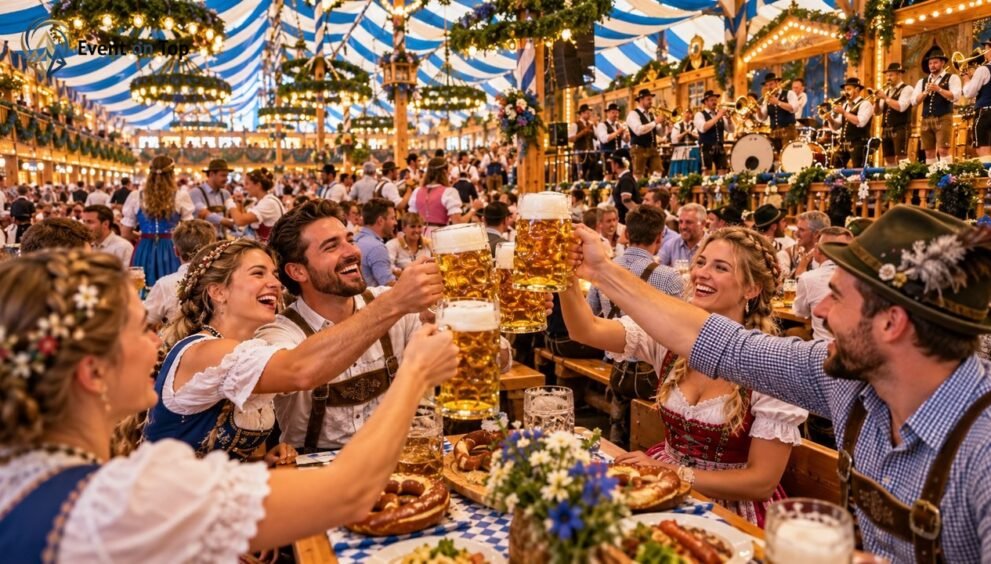
Around seven million visitors a year make this the world’s largest folk festival — a working funfair of roller coasters and carousels wrapped around fourteen giant brewery tents, each run by one of Munich’s historic breweries, seating thousands at long communal tables with brass bands, roast chicken and one-litre steins (Maß) of specially brewed Oktoberfest beer. It is a local family festival as much as a global party, and understanding that balance is the key to enjoying it.
A Short History in 60 Seconds
Oktoberfest began as a wedding party. On 12 October 1810, Crown Prince Ludwig of Bavaria married Princess Therese of Saxe-Hildburghausen, and Munich celebrated with horse races on the meadow outside the city gates — the Theresienwiese, “Therese’s meadow”, still the festival’s home and the reason locals call it the Wiesn.
The races and the party proved so popular that the city repeated them the following year, and an agricultural fair grew up alongside. Through the 19th century the festival lengthened and moved earlier into September — for the warmer evenings and better weather, which is why most of “Oktoberfest” now happens before October starts. The big brewery tents arrived in 1896, when the first giant halls replaced smaller beer booths, and the modern shape of the festival — tents, funfair, parades, around six to seven million visitors in recent years — built from there. The barrel-tapping ceremony, the costume parade and the Oide Wiesn historical section (see below) are all later additions that now feel timeless.
How the Tents Actually Work
The single most misunderstood thing about Oktoberfest is the tents. Walking in is free, but on busy days — opening weekend, weekends, evenings — the big tents fill and close their doors, sometimes by late morning. Reserved tables are the guarantee: breweries and tent hosts open table reservations (typically for tables of 8–10, usually with a minimum consumption arrangement in food and drink vouchers) through their own official channels months in advance, and they sell out. Unreserved sections exist in every tent and turn over all day, so the classic tactics work: arrive before midday on weekdays, take lunch inside a tent while tables are findable, and treat evenings on spec as a bonus rather than a plan.
| Tent style | Examples | Best for |
|---|---|---|
| Giant brewery tents | Schottenhamel, Hofbräu-Festzelt, Augustiner-Festhalle, Löwenbräu-Festzelt | The full-throated classic experience; Hofbräu is the most international, Augustiner a local favourite |
| Smaller traditional tents | Smaller brewery and family tents around the ground | Easier entry, calmer pace, same beer strength |
| Fischer-Vroni | The fish tent — grilled fish on sticks (Steckerlfisch) is the speciality | A break from roast meat, and a tent with its own loyal local following |
| Ochsenbraterei | Spaten tent famous for ox dishes, roasted in view of diners | Food-first visitors; the ox menu is the point, not a side line |
| Oide Wiesn (Old Oktoberfest) | The separate, quieter historical section of the ground (small entry fee in recent years) | Vintage rides, traditional music, families, breathing space |
Only six Munich breweries may serve beer at Oktoberfest — the “Big Six”: Augustiner, Hacker-Pschorr, Hofbräu, Löwenbräu, Paulaner and Spaten. Every large tent pours one of their specially brewed Oktoberfest beers (around 6% strength), and regulars choose tents partly by brewery: Augustiner, served from wooden barrels, has a devoted local following; Hofbräu draws the most international crowd; Schottenhamel is where the Lord Mayor taps the first barrel, so it fills first on opening day.
The Oide Wiesn deserves more than a table row. It is a fenced historical section in the southern part of the ground recreating the festival of a century ago: vintage rides at gentler prices than the main fairground, traditional music and dancing, and tents run at a calmer volume. Entry has carried a small fee in recent years (a few euros, with the ticket usually valid all day — confirm the 2027 arrangement nearer the time), and children and families are steered here for good reason. If the main tents overwhelm you by day two, an afternoon in the Oide Wiesn is the reset locals recommend.
The two parades are worth planning around: the landlords’ and breweries’ entry parade on opening morning, and the Traditional Costume and Riflemen’s Parade on the first Sunday (19 September 2027), one of the largest of its kind in the world, winding through the city centre to the Wiesn.
What Does Oktoberfest Cost?
Official beer prices for 2027 have not been announced — they are set each year and published in the run-up to the festival. For scale, in 2026 a Maß (one litre) cost roughly €14.80–€15.90 in the standard tents, so budget a little above that for 2027 and confirm nearer the time. Food anchors the budget honestly: half a roast chicken, a pork knuckle with dumplings, or giant pretzels run from the high single digits to the €20s depending on dish and tent, and the lunchtime specials in tents on weekdays are the insider’s discount. Add fairground rides at a few euros a go, a gingerbread heart or stein as a souvenir, and the real lever is accommodation: Munich hotel prices multiply during the Wiesn, and booking many months ahead (or staying on an S-Bahn line outside the centre) is where the serious money is saved.
Oktoberfest Prices at a Glance
The table below uses the last published prices (2026) as the planning anchor. Official 2027 prices are announced in the run-up to the festival — expect a similar range and confirm nearer the time.
| Item | Typical price (2026 anchor) |
|---|---|
| Maß of Oktoberfest beer (1 litre) | €14.80–€15.90 |
| Non-alcoholic beer or soft drink (1 litre) | Roughly €11–€15 |
| Half roast chicken (Hendl) | Roughly €15–€23 depending on tent |
| Giant pretzel (Riesenbrezn) | Roughly €6–€8 |
| Pork knuckle / main dish | Roughly €20–€30 |
| Fairground ride | A few euros per ride; vintage Oide Wiesn rides less |
| Munich day ticket (public transport) | Single-digit euros for the inner zone |
Add it up and one relaxed day on the Wiesn — two to three Maß or equivalents, a proper tent meal, a pretzel, two rides and transport — comes to roughly €70–€110 per person before accommodation. Heavy tent evenings cost more; a weekday lunch using the tents’ lunchtime specials costs noticeably less.
What a Whole Trip Costs: Three Worked Examples
For two days / two nights per person, based on typical Wiesn-season prices at the time of writing (estimates, not quotes):
| Profile | Hotel (2 nights) | Food, drink, rides (2 days) | Total guide |
|---|---|---|---|
| Budget — hostel or S-Bahn-line hotel, weekday visit | €90–€160 | €120–€170 | ≈ €210–€330 |
| Mid-range — central hotel booked months ahead | €300–€550 | €180–€260 | ≈ €480–€810 |
| Comfort — walking-distance hotel, weekend, reserved table | €600–€1,100+ | €260–€400 | ≈ €860–€1,500+ |
Travel to Munich is on top of these figures. The pattern to notice: the beer price everyone asks about is a small part of the total — the hotel line decides which profile you land in. For places to compare with the year in festivals, see our guide to the top cultural festivals in the world in 2027.
Cash versus card: the ground has become increasingly card-friendly, but carry euros for smaller stalls, lockers and tips. There are ATMs on site, at predictable queues. Tipping in tents is customary — your server (Bedienung) works a system in which rounding up genuinely matters, and looking after them early in a long session is the oldest Wiesn wisdom there is.
What to Wear: Dirndl, Lederhosen and the Dress Code That Isn’t
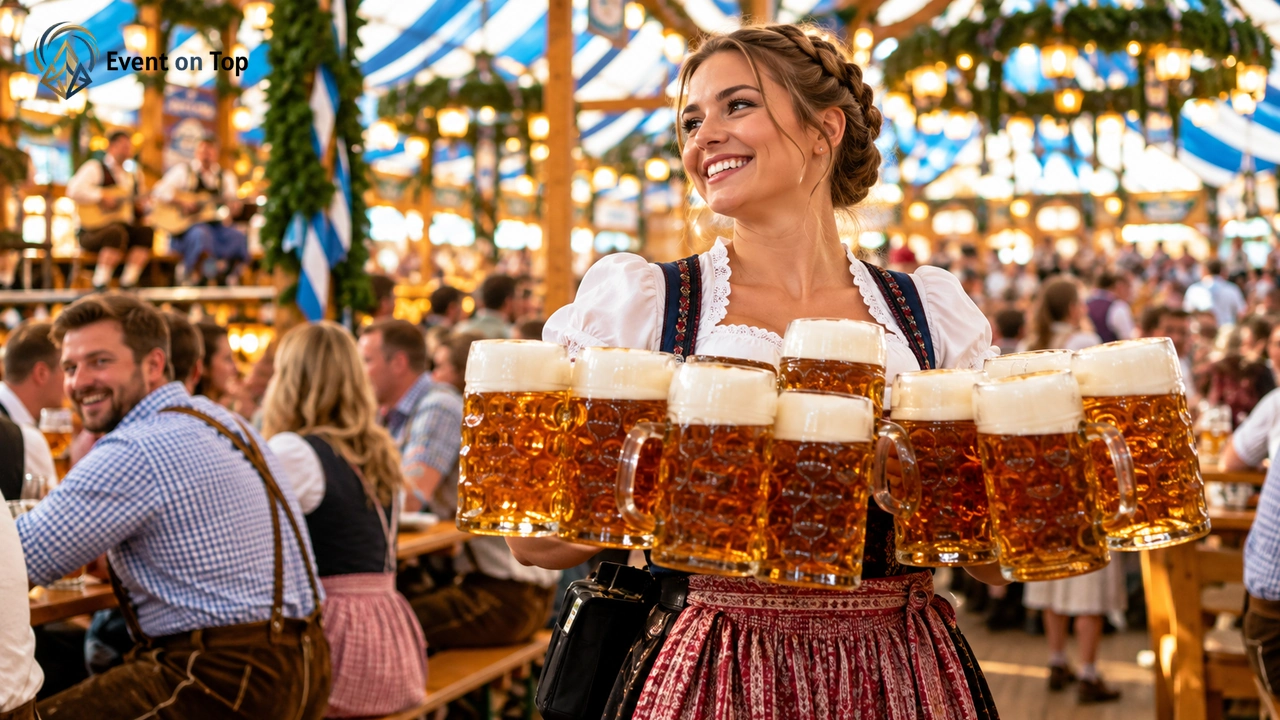
There is no dress code at Oktoberfest. You can walk into any tent in jeans and a jumper and be served exactly the same beer. But a large share of locals and a growing share of visitors wear Tracht — traditional Bavarian dress — and joining in, done properly, is part of the fun rather than fancy dress.
For women, the outfit is the dirndl: a fitted dress with a bodice, a blouse underneath and an apron tied at the waist. Local folklore reads the apron bow as a signal — tied on the wearer’s right is traditionally said to mean taken, on the left, single; treat it as a charming tradition people mention, not a rule anyone polices. For men, it is lederhosen: leather shorts or knee-length breeches with braces, a checked or plain shirt, thick socks and sturdy shoes. Both outfits are worn with completely straight faces by Munich locals of every age, which is why cheap shiny fancy-dress versions stand out so badly.
Your three realistic options: buy properly — a modest real dirndl or lederhosen set in Munich typically runs from around €80–€150 upwards at the time of writing, and you will own it for every future festival; rent locally — Munich rental shops do a heavy Wiesn trade at lower cost for a few days, but book early because sizes disappear in the first week; or skip Tracht entirely and wear smart-casual clothes you can stand, sit and dance on a bench in. Whichever you choose: wear shoes you have already broken in, bring a layer for the walk home (September evenings cool fast), and remember tents are warm inside even when the fairground is not.
Where to Stay for Oktoberfest
For Oktoberfest, where you sleep matters more than almost any other decision in this guide — Munich hotel prices multiply during the Wiesn, and the same room can cost two to four times its normal rate. Book as early as you can, ideally on a refundable rate, and choose your area by how you plan to get home at night.
| Area | Why stay there | Typical Wiesn price band per night (at the time of writing) |
|---|---|---|
| Ludwigsvorstadt / Schwanthalerhöhe, near the Wiesn | Walk to the tents and walk home; no transport queues at closing time | Mid-range rooms roughly €175–€450; luxury €400–€900+ |
| Hauptbahnhof (main station) area | 15-minute walk to the ground, best transport links, huge choice of hotels | Hostels and budget rooms roughly €50–€120; mid-range €150–€350 |
| Maxvorstadt / Schwabing | Quieter, prettier districts a short U-Bahn ride away; better value for the same quality | Mid-range roughly €130–€300 |
| Towns on the S-Bahn lines | The budget play: family-run hotels in suburbs and nearby towns, 20–40 minutes by train | Often €60–€130 even during the Wiesn |
These bands are indicative ranges from recent Wiesn seasons, not quotes — opening and closing weekends price highest, weekday nights in the second week price lowest. Two tactics save real money: stay Sunday to Thursday instead of across a weekend if your dates allow it, and check the last S-Bahn times before booking a suburban bargain, so the saving does not end in a taxi queue. If you are combining the trip with other stops, our guide to planning a trip around a major event covers the booking order that keeps options open.
First-Timer Tips That Actually Help
Wear the outfit or don’t — both are fine — but know that dirndls and lederhosen are normal local dress here, not costumes, and cheap novelty versions are spotted instantly; renting locally or buying a modest real one beats fancy dress. Pace the beer: Oktoberfest beer is stronger than standard lager (around 6%), served in litres, at altitude-ish enthusiasm — alternating with water and eating properly is not soft, it is strategy. Tuesday afternoons are family time with reduced ride prices; weekday lunchtimes are the calmest tent hours overall. Leave big bags at the hotel (there are storage facilities, with rules and fees), expect bag checks at entrances, and note that the tents stop serving at 10:30 p.m. — the festival’s afterlife continues in the city’s beer halls and bars. Finally, book your Munich accommodation before anything else: for Oktoberfest, the hotel market, not the beer price, decides what your trip costs.
Is Oktoberfest Safe?
Oktoberfest is a heavily managed event with a strong safety record for its size. Expect bag checks at the entrances — large bags and backpacks are not allowed inside the ground, which is why storage facilities exist outside it — plus a visible police and medical presence throughout, marked first-aid points, and crowd management that closes individual tents and entrances when areas reach capacity. Follow the practical basics: agree a meeting point with your group in case phones die or signal fails under the crowd load, keep your bearings on which entrance you came in, pace the 6% beer (see above), and use the staffed information and help points rather than wandering if you feel unwell. Munich also runs dedicated safe-space and assistance services during the festival, signposted on site and in the official festival information.
Picking Your Days: A Crowd Calendar in Brief
Not all sixteen days are equal. Opening Saturday (18 September 2027) is ceremony and chaos — arrive before noon or watch the tapping on a screen. First-week weekdays are the sweet spot: full atmosphere, findable tables. The middle weekend traditionally draws the largest visiting crowds of the festival — it is famously popular with Italian visitors — and the tents fill earliest then. Family Tuesdays (both weeks) bring reduced ride prices and the calmest afternoons. Closing weekend (2–3 October) is emotional, packed and, for many locals, the favourite — the festival ends on the evening of 3 October. Choose weekdays if the beer matters most, a weekend if the spectacle does.
Getting to the Wiesn
The Theresienwiese has its own stations and you should use them — driving into central Munich during the festival is a mistake in every language. The U-Bahn stations Theresienwiese (U4/U5) exits inside the festival’s edge and gets extremely busy at peak times; the insider alternatives are Hackerbrücke (S-Bahn) or Goetheplatz and Poccistraße (U3/U6), each a short walk that spreads the crowd. From the airport, the S-Bahn or the airport bus reaches the centre in around 40 minutes, and Munich’s transport runs extended services through the festival, including through the night at weekends. If you are staying outside the city, note your last sensible connections before your third Maß, not after it. Cyclists get dedicated parking near the ground, taxis and ride-hailing have set drop-off points, and the walk from the Hauptbahnhof (main station) is only about fifteen minutes — for many visitors staying near the station, the classic and simplest route of all.

Frequently Asked Questions
When is Oktoberfest 2027?
From Saturday 18 September to Sunday 3 October 2027 on the Theresienwiese in Munich, opening with the traditional barrel-tapping at noon on 18 September.
Do I need a ticket for Oktoberfest?
No. Entry to the grounds and the beer tents is free and there is no general admission ticket. What you may want is a table reservation inside a tent — booked through the tents’ official channels — because unreserved space disappears fast at peak times.
How much is a beer at Oktoberfest 2027?
2027 prices have not been announced yet. In 2026 a one-litre Maß cost about €14.80–€15.90 in the standard tents; expect a similar range, confirmed by the official price announcement closer to the festival.
What is the best day to visit Oktoberfest?
Weekdays, especially in the first week, for findable tables and shorter queues. Opening weekend and the final weekend are the most atmospheric and the most crowded; family Tuesday afternoons are the calmest.
Can families bring children to Oktoberfest?
Yes — it is a folk festival with a funfair, and children are everywhere during the day. Children under six must leave the tents by 8 p.m., and smaller children are best kept to daytime hours and the Oide Wiesn.
How do I reserve a table in an Oktoberfest tent — and when do bookings open?
Reservations are made directly with each tent through its official website or reservation office — there is no central booking system. Each tent opens its booking window at its own time, typically in the months before the festival (many in spring and early summer), and popular slots — evenings and weekends — sell out fast. Reservations are normally for a whole table of 8–10 people and usually require buying food and drink vouchers in advance to a minimum value, which is then spent at the table. Set a reminder for your chosen tent’s window rather than relying on leftovers in September, and never buy “reservations” from unofficial resale adverts — a reservation is a voucher arrangement with the tent, not a transferable entry ticket, because entry itself is free.
How much money do I need per day at Oktoberfest?
For a relaxed day — two to three litres of beer or equivalents, a proper tent meal, a snack, a couple of rides and local transport — budget roughly €70–€110 per person at 2026 prices, with 2027 prices to be confirmed. A quiet weekday built around a lunchtime special can come in below that; a long Saturday in a big tent will go above it. Add your hotel night on top — during the Wiesn that is usually the bigger number. Carry some cash even though card payment is now widely accepted, especially for smaller stalls, lockers and tips.
Conclusion
Oktoberfest 2027, 18 September to 3 October in Munich, rewards two simple moves: book your bed early, and aim for a weekday lunch in a great tent. Entry is free, the beer price will land in the mid-teens per litre, the costume parade is on 19 September — and the rest is brass bands, new table friends, and the largest good mood in Europe.
Planning a festival year in Europe? Pair this with our Glastonbury 2027 guide for June and the Best Christmas Markets in Europe 2026 guide for December, or browse more in our Cultural category.


Top 12 Cultural Festivals in the World in 2027
24th Oct 2026[…] dress, brass bands, fairground rides and fourteen great tents — guide and tent strategy in our Oktoberfest guide. Día de los Muertos (1–2 November, Oaxaca) — cemeteries glowing with marigolds and candles, […]