











Classroom Halloween Party Games for Teachers: Low-Prep, No-Food Station Ideas


Classroom Halloween Party Games for Teachers: Low-Prep, No-Food Station Ideas
Halloween 2026 falls on a Saturday (October 31), so the classroom action happens a day or two earlier — Thursday, October 29 and Friday, October 30 — when teachers run the party inside a school day. The constraints are familiar: 25-plus kids, 30 to 45 minutes, a room full of furniture, and food rules that rule out candy-fuelled party games altogether.
This guide is built inside those constraints. Every game below is food-free, uses materials already sitting in a classroom cupboard, and takes five minutes or less to set up. They are organised two ways: by format (whole-class and station games, plus 10-minute fillers for the gaps) and by age band (K–2, grades 3–5, and middle school). Also included: a calm corner for kids who find parties a lot, prize-free rewards, and a setup-and-cleanup checklist. If your school does allow treats, pair these games with our guide to school-safe Halloween classroom snacks so the food side stays nut-free and label-checked.
Running a 30–45 Minute Classroom Party (The Station Rotation)
The station rotation is what makes a short party feel big. Set up four stations around the room, split the class into four groups of five to seven, and give each group seven minutes per station with a one-minute move between rounds. A timer on the board runs the whole thing: when it buzzes, groups rotate clockwise. Four rounds, one complete party, inside half an hour.
Three things make it work. First, demo the freeze signal before you start — music stops or timer buzzes, hands on heads, voices off. Practise it once and the party basically manages itself. Second, put a one-line instruction card at each station so groups can begin without waiting for you. Third, keep the filler games from the next section (Would You Rather, Monster Charades) in your pocket for early finishes and stalled transitions. Treat the age bands below as a starting point, not a label — you know which of your second-graders could run a trivia round.
Whole-Class Games (No Running, No Chaos)
For the opening and closing minutes — or rooms where stations won’t fit — these four games run with everyone seated or in a carpet circle.
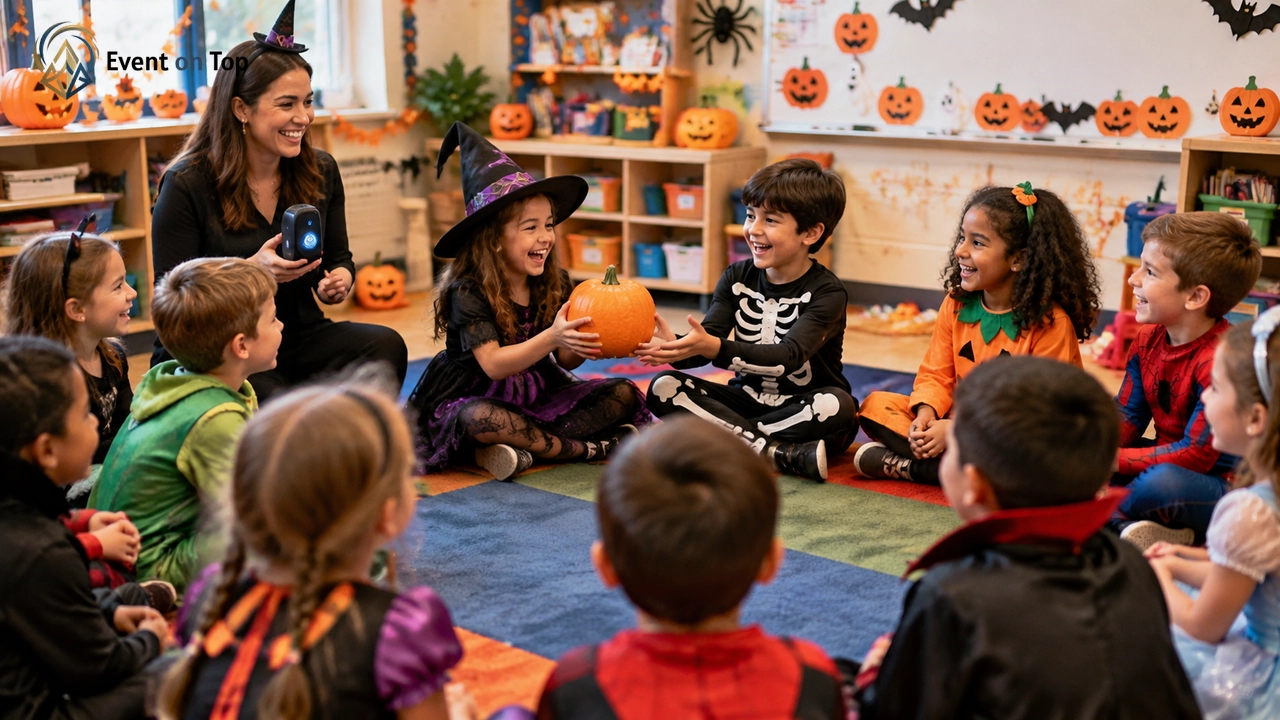
Pumpkin Pass — Materials: one soft foam pumpkin, beanbag, or ball of orange paper; a music player. Setup: 1 minute. How to play: the class sits in a circle and passes the pumpkin while the music plays. When it stops, whoever is holding it answers a silly Halloween question (“Would you rather fly a broom or sleep in a castle?”) or does a five-second monster impression. Nobody is ever “out” — the holder just starts the music for the next round. Cleanup: none; the pumpkin lives in the games cupboard.
Halloween Bingo — Materials: printed picture bingo cards (one reusable set), squares of scrap paper as counters. Setup: 5 minutes to hand out. How to play: call out Halloween words — ghost, pumpkin, spider, moon — while kids cover the matching picture; the first full row shouts “Boo-go!” Play two or three rounds, then finish with a blackout (full-card) round so more children win. Cleanup: counters into a tub, cards back in their envelope — a good job for two helpers.
Would You Rather: Halloween Edition — Materials: none, or a short list of questions on the board. Setup: zero minutes. How to play: read a pair (“Trick-or-treat at a haunted house or in a corn maze?”) and students vote by pointing left or right, then one or two defend their answer in a sentence. It doubles as the party’s filler bank and fills 10 minutes easily. Cleanup: none.
Monster Charades — Materials: a hat or bowl of folded action cards (“a cat stretching”, “a witch stirring a pot”, “a mummy waking up”). Setup: 2 minutes. How to play: one volunteer acts at the front — no words, no sounds — while the class guesses from their seats; the correct guesser becomes the next actor. Keep rounds under a minute so turns keep moving. Cleanup: cards back in the hat.
Station Games for K–2
For five-to-seven-year-olds, stations should be visual, physical in a small space, and winnable by everyone. These four run on a table or a taped floor zone.
Pin the Nose on the Pumpkin — Materials: a large paper pumpkin taped to the board or wall, paper triangle “noses” with tape loops, a soft blindfold. Setup: 5 minutes. How to play: each child, blindfolded, takes two steps forward and sticks their nose on the pumpkin; mark each attempt with an initialled sticker dot. The closest nose at the end of the rotation earns the big cheer, and the pumpkin stays up as decoration. Cleanup: peel off the tape at day’s end; the pumpkin recycles or saves flat for next year.
Pumpkin Bowling — Materials: six empty plastic bottles with a paper ghost face on each, one soft playground ball. Setup: 3 minutes. How to play: bottles stand at the end of a taped lane; children roll, never throw, from the line — two rolls per turn — and count the ghosts they knock down. A group member resets the pins between turns; at this age the resetting is half the fun. Cleanup: bottles into the recycling or back in a crate for next year.
Witch Hat Ring Toss — Materials: three cones (make them from black card in advance, party-hat style) and rings — glow bracelets, embroidery hoops, or rings cut from paper plates. Setup: 5 minutes making cones, 1 minute on the day. How to play: hats sit at two distances — near hat 1 point, far hat 3 points — three throws per child, the group keeping score on the station card. Cleanup: cones stack inside each other; rings go in a zip bag.
Cauldron Toss — Materials: a plastic cauldron, bucket, or laundry basket, and five beanbags or balled socks. Setup: 1 minute. How to play: stand behind the tape line and toss all five beanbags, counting how many land in; then fetch them and hand over to the next player — the fetching is built into the play, so there is no dead time. Cleanup: beanbags live in the cauldron; done in seconds.

Station Games for Grades 3–5
Older elementary kids want a scoreboard, a timer, and a challenge. These four deliver, each inside one station zone.
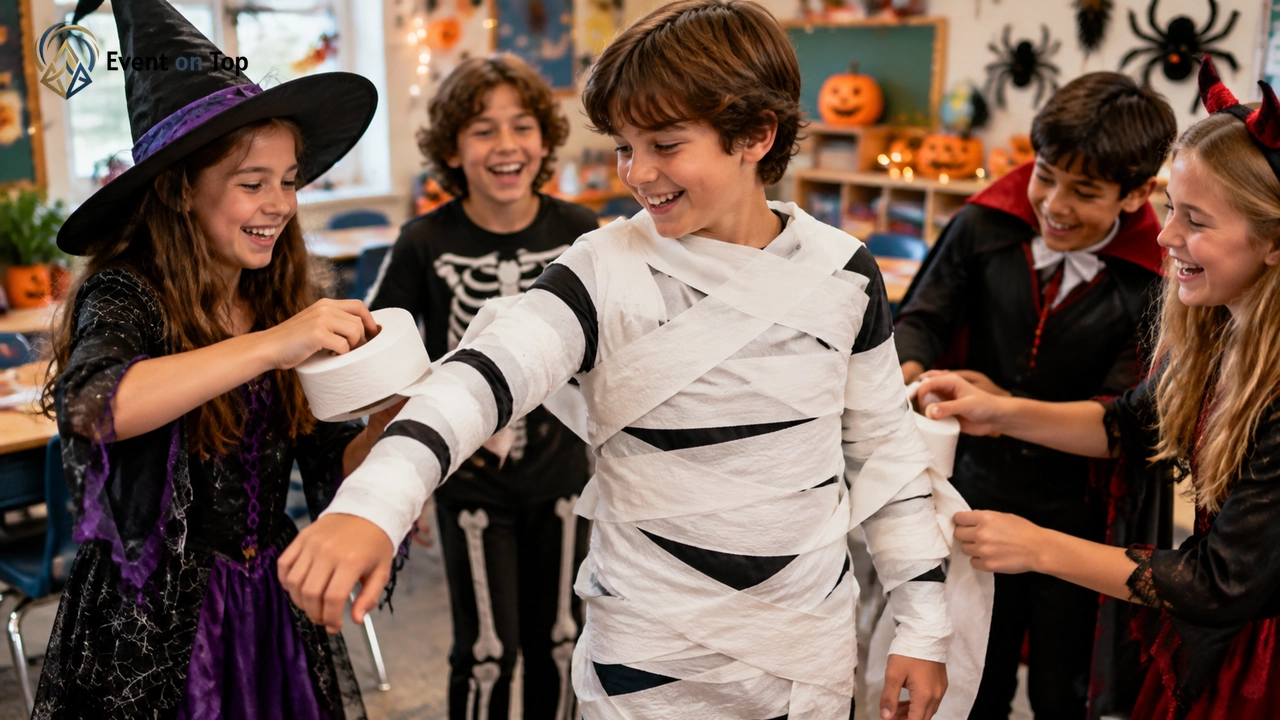
Mummy Wrap — Materials: one toilet paper roll per pair. Setup: 1 minute. How to play: in pairs, one partner wraps the other from shoulders to ankles in two minutes flat — never covering faces — while a third student times and a fourth judges neatness. Then swap. Cleanup: this is the one game with real cleanup, so build it into the play: each pair bags its own paper at the station before rotating.
Roll-and-Draw a Monster — Materials: one die per group, paper, pencils or crayons. Setup: 1 minute. How to play: the station card maps die rolls to features — roll for eyes (a 1 means one eye, a 6 means six), roll again for legs, horns, and wings. Everyone draws the monster the dice describe, then the group votes on the silliest. Quiet, absorbing, and it produces instant wall decoration. Cleanup: drawings go home or on the wall; pencils back in the pot.
Classroom Scavenger Hunt — Materials: printed clue cards hidden around the room before the party. Setup: 10 minutes of hiding time — the longest setup here, done once for all rotations. How to play: each group follows its clue chain (“I sit where stories live” leads to the book corner), collecting a letter at each stop that spells a Halloween word at the end. Cleanup: the final group collects the cards as its last clue. For full ready-to-use clue sets — indoor, outdoor, and a classroom version — see our Halloween scavenger hunt clue sets.
Eyeball Spoon Carry — Materials: spoons, and ping-pong balls with a dot drawn on each as an “eyeball”. Setup: 2 minutes to tape a short walking course. How to play: carry the eyeball around the course — walking only; if it drops, freeze, pick it up, and restart that leg. Log each time on the station card; the fastest clean run of the party gets the applause. Cleanup: balls and spoons into a cup; tape peeled up.
Middle School Tweaks (Grades 6–8) — The station format still works if the games grow up. Swap bingo for a Halloween Trivia Tournament: teams, hands-on-desk buzzers, questions on the board, a running scoreboard across the party. Swap the cauldron toss for Ghost Dash: blow a cotton ball across a desk with a straw, first to the finish line — absurdly competitive. And swap roll-and-draw for a Haunted House Design Challenge: graph paper, ten minutes, teams draft a haunted house floor plan and pitch its scariest room in 30 seconds. Middle schoolers will pretend to be above all of this, then play every game twice.
The Calm Corner: Quiet Options for Sensitive Kids
Every class has kids for whom a loud party is simply too much — and kids who just prefer quiet. Make the calm corner one of the stations, not an escape route, so it never marks anyone out: every group rotates through it, and anyone can land there in free-choice minutes.
Stock it with pumpkin coloring and design sheets, a Halloween word search, sticker-scene pages, “design your dream costume” drawing paper, and a few fall picture books (gentle spooky stories for older classes). Keep the expectation at this station to whispers — it is the one corner where nothing jumps, buzzes, or shouts. Cleanup: a tray for finished pages and pencils in a pot — it tidies itself as groups rotate.
Prize-Free Rewards That Still Feel Like Winning
With candy and plastic prizes off the table in most schools, make the rewards social — for seven-year-olds and twelve-year-olds alike, status beats stuff. Winners and winning groups can: choose the cleanup music; pick the next filler game; become station captain for the next round; earn a paper Golden Pumpkin award that lives on their desk for the week; choose Friday’s read-aloud; or take the genuine honor of the teacher’s reading chair for the closing game. Then end with a reward everyone shares — a five-minute whole-class finale of Pumpkin Pass — so the last memory is collective, not competitive.
Setup & Cleanup Checklist
- The day before: print bingo and clue cards; make the ring-toss cones; assemble the cauldron, beanbags, and instruction cards.
- Morning of: tape the floor zones and bowling lane; set up the rotation timer; lay out the calm corner tray.
- First two minutes of the party: demo the freeze signal and run one practice freeze before any game starts.
- During: you float — the station cards and group captains run the games.
- Final five minutes: music on, every group tidies the last station it played (paper bagged, cards stacked, props boxed), then the whole-class finale.
- After the bell: one box holds everything reusable for next year — bingo set, paper pumpkin, cones, and instruction cards.

Frequently Asked Questions
How long should a classroom Halloween party last?
Thirty to forty-five minutes is the sweet spot. The rotation in this guide — four stations at seven minutes each, plus one-minute moves — fills about 35 minutes and leaves a buffer for the demo and closing game — exactly the window most schools allow.
How many stations do I need for a class of 25–30 students?
Four. Groups of five to seven keep every child playing instead of queuing. Fewer stations and lines form; more and setup time starts eating the party itself. A smaller class can run three stations with longer rounds.
What if my school doesn’t celebrate Halloween?
Run the identical format as a fall or harvest party. Keep the games, change the dressing: pumpkin bowling becomes harvest bowling, the monster drawing becomes a scarecrow drawing, and the trivia turns to autumn. No costume is required in either version.
How do I include kids who don’t take part in Halloween activities?
Make the calm corner a normal station that every group rotates through, never a separate space for separate kids. Helper and station-captain roles let any child help run the party without playing a particular game, and the K–2 games are built around pumpkins and play, not anything frightening.
Can I run all of this without parent volunteers?
Yes — that is the design brief. The timer runs the schedule, the instruction card at each station explains the game, and a rotating station captain keeps score. One floating adult is enough for every game here.
A Party That Ends With You Wanting to Do It Again
The best classroom Halloween party ends with the room tidy, the class happy, and nobody — including you — vowing “never again.” The secret is format, not budget: four stations, a timer, games nobody needs candy to win.
Beyond the classroom — zoo nights, trunk-or-treats, and not-so-scary events for Halloween weekend — see our guide to family Halloween events.


Halloween Scavenger Hunt: Free Printable Clue Sets for Kids, Teens & Adults
28th Oct 2026[…] Classroom Halloween Party Games for Teachers: Low-Prep, No-Food […]