








Halloween Potluck Ideas: What to Bring That Travels Well & Feeds a Crowd

Halloween Potluck Ideas: What to Bring That Travels Well & Feeds a Crowd
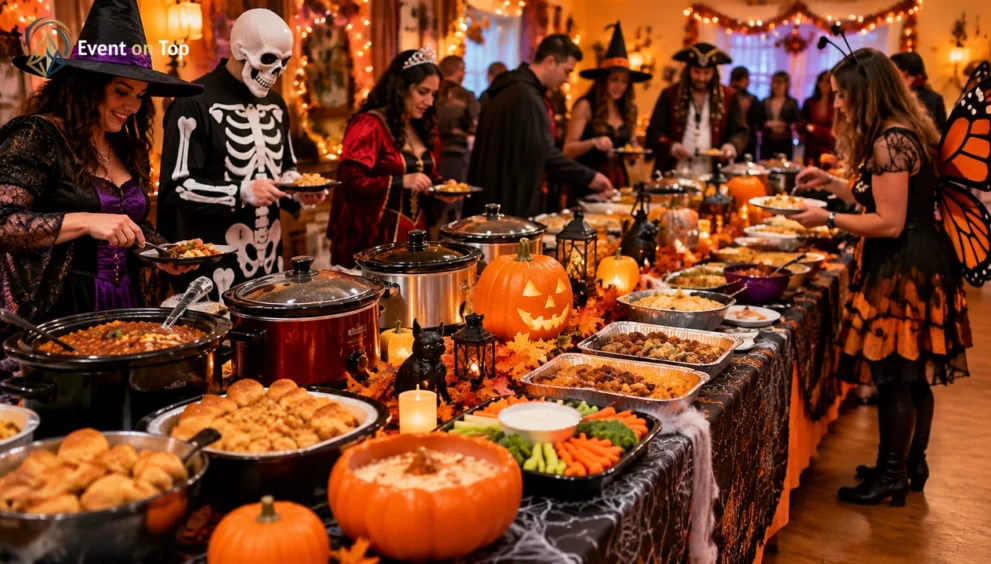
Every Halloween potluck has the same origin story. Nobody coordinates, everybody guesses, and the table ends up with four trays of brownies, two identical cheese balls, and nothing anyone could call dinner. Halloween 2026 falls on Saturday, October 31, so most parties land on the night itself — no second chances, just a house full of costumed guests grazing for hours.
The fix is not better cooking. It is coordination, dishes chosen for the journey as much as the table, and a little respect for the clock once food leaves the oven. This guide covers both chairs: the host setting up a sign-up that balances the table, and the guest choosing a dish that travels well, holds up on the counter, and still tastes like itself at hour two. Building the rest of the party too — games, decor, the works? Our full Halloween party ideas guide has the complete playbook; here, we stay on the food.
Potluck Rules That Prevent Twelve Desserts (Sign-Up Categories)
Dessert duplication is not a guest problem; it is a sign-up problem. Left to choose freely, most people pick the safest, sweetest category. A sign-up with named categories fixes the table before anyone preheats an oven.
Use five categories: Mains, Slow-Cooker & Make-Ahead Dishes, Snacks & Sides, Desserts, and Drinks & Supplies. Drinks and supplies belong on the same sheet — ice, cups, plates, napkins, and serving spoons are contributions too, and listing them gives non-cooks a real job. As host guidance, aim for roughly one main for every eight to ten guests, then fill around them; guests graze and sample rather than eat full portions, so a dish that serves eight at dinner covers more people here.
Three rules keep it working:
- First come, first served — by category. When a category fills, it closes. The sixth person who wants to bring brownies gets pointed at the empty drinks slot.
- Name the dish, not just the category. “Chili” on the sheet stops the second chili. Vague entries (“a side”) are how duplicates sneak back in.
- Ask for an ingredients line. Every entry includes the dish name and its main ingredients. That one habit powers the allergy labeling later in this guide, and it costs the guest thirty seconds.
Hosts: provide the foundation regardless of the sheet — plates, cups, cutlery, ice, water, and one anchor main of your own, so the party survives a no-show.

Mains That Travel Well
The best potluck main is not the best dish you cook. It is the best dish you cook that survives a car ride and forty minutes of small talk. Judge every candidate against three tests: it holds heat or tastes right at room temperature, serves with one hand and a spoon, and needs no carving, tossing, or assembly at the host’s counter.
Dishes that pass all three:
- Pulled pork or shredded chicken sandwiches. Cook the meat in its sauce, transport it in the cooking pot, and send rolls separately in their bag so nothing goes soggy. Guests build their own, which quietly solves portions.
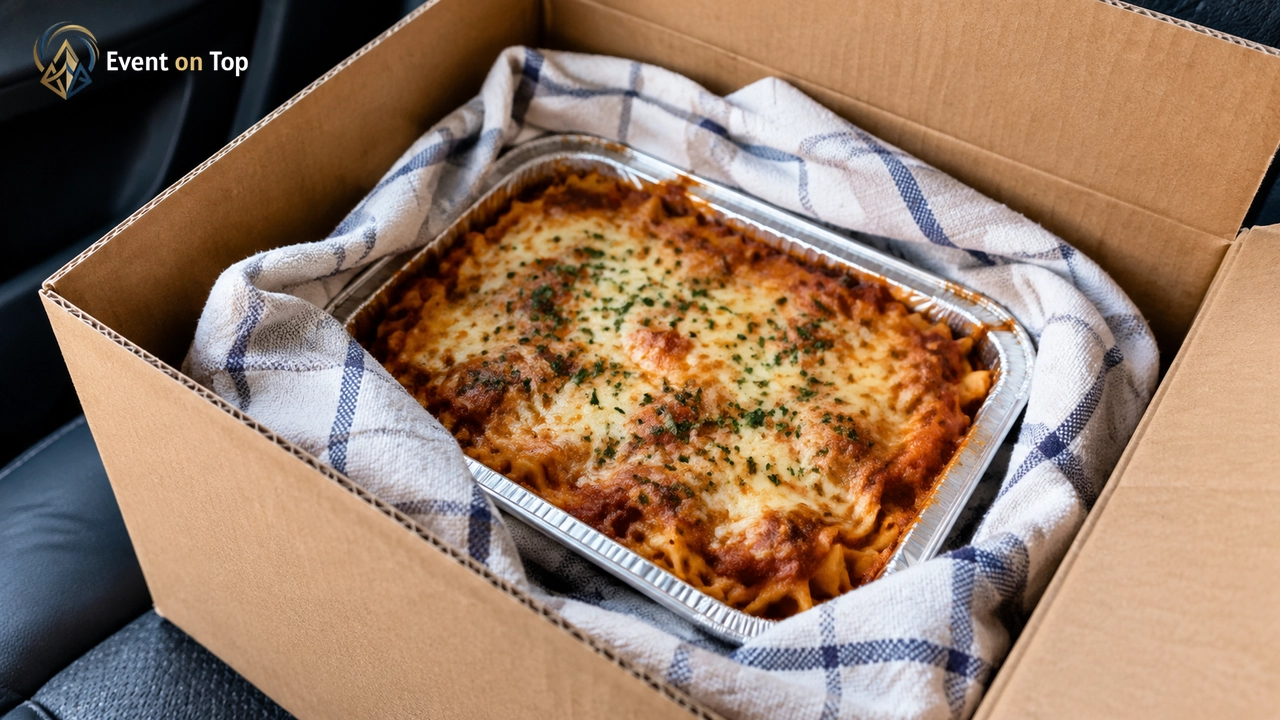
- Baked pasta. A foil pan of baked ziti or lasagna travels like it was designed for it — because it was. It holds heat under foil and feeds a crowd from one pan.
- Meatballs in sauce. Cocktail or sandwich size, simmered in the sauce they travel in. Toothpicks for grazers, small rolls for the hungry.
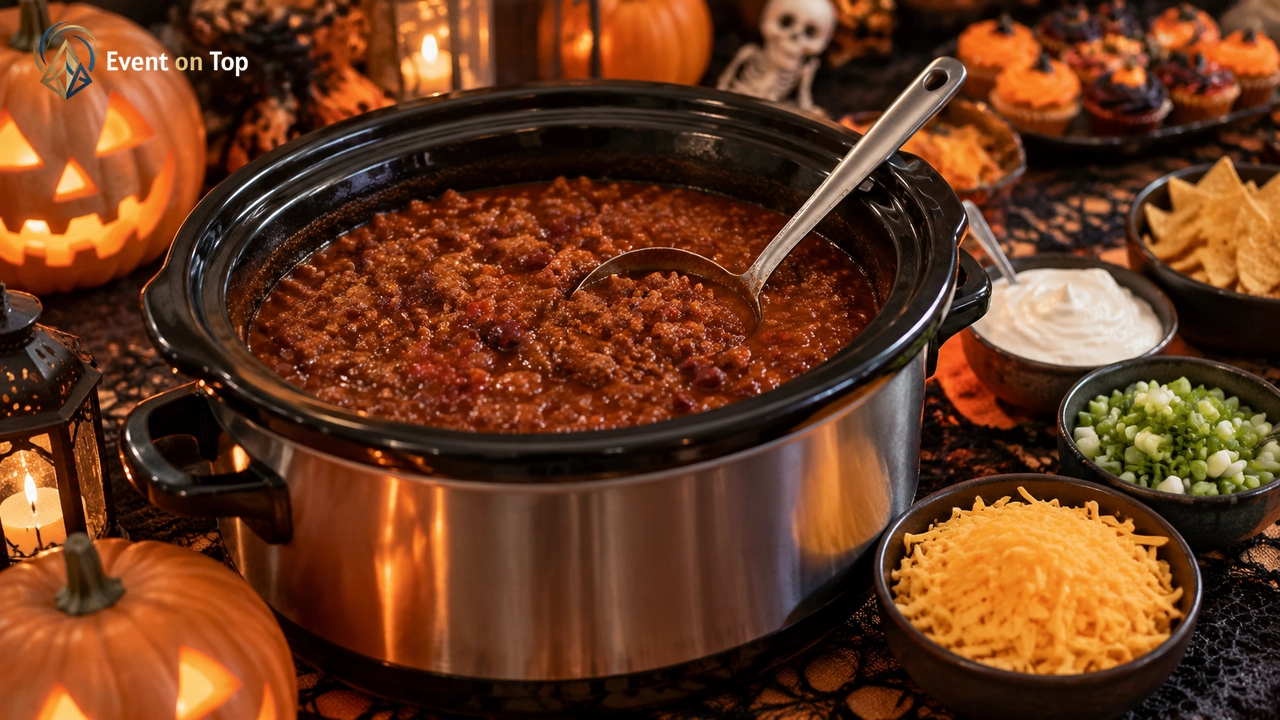
- Chili. Beef, turkey, or a bean-and-vegetable pot for meat-free guests — chili improves after a rest and reheats without complaint. Send toppings (cheese, sour cream, chopped onion) in separate small containers.
Travel mechanics matter too. Wrap a hot pan in a towel and set it flat in a cardboard box; a pan that cannot slide cannot spill. Sauces go in jars with tight lids, separate from anything crisp. Load the car last: every minute in a cold trunk comes off the dish’s serving window, which the food-safety section below treats as sacred.
Slow-Cooker & Make-Ahead Dishes
The slow cooker is the potluck’s best technology, because it is three things at once: the cooking vessel, the transport container, and the serving station. A dish that arrives in a plugged-in slow cooker holds itself at serving temperature all evening — no oven space negotiated.
Strong slow-cooker choices for a Halloween table:
- Chili and soups. Day-before dishes by design — the flavors settle overnight, and party day becomes a reheat instead of a project.
- Warm dips. A spinach-and-artichoke dip or a melted cheese dip stays scoopable for hours on the warm setting, where a baked dip on the counter would seize up.
- Baked beans and glazed meatballs. Sweet, sturdy, and forgiving about timing — both are better on day two than hour one.
- Mulled apple cider. The cooker doubles as the drink station, and the house smells like fall as a side effect.
Transport it like it matters: lid latched or held with a bungee, cooker upright in a box or footwell — never on a slanted seat — with a towel underneath for the spill you do not expect.
Make-ahead cold dishes pull their weight too. Pasta salad (dress it lightly before travel, add the rest of the dressing on arrival), pinwheel sandwiches rolled and sliced the night before, and deviled eggs — piped with a dot of olive on top, they become little monster eyes without a single special ingredient. Nearly everything in this section is finished before party day, which is the real recipe.
Spooky Snacks & Sides
Snacks are where Halloween theming earns its keep — a plain dish with a spooky presentation beats an elaborate one nobody recognizes. Build the base at home; add the fragile decoration on arrival.
- Pumpkin cheese ball. Any sturdy cheese-ball mixture shaped into a pumpkin — score the grooves with a knife, add a bell-pepper stem — travels in its container and gets unveiled at the table. Ten minutes of shaping, all evening of compliments.
- Spiderweb layered dip. A bean-and-guacamole layered dip in a wide, shallow dish; pipe a web of sour cream on top and drag a toothpick through it. Make the web on arrival — it takes two minutes and smears in the car if you do it before.
- Vegetable skeleton. Arrange cut vegetables into a skeleton shape on the platter — a small bowl of dip as the skull — covered tightly with wrap for the trip. It costs nothing but arrangement, and it is usually the most-photographed dish on the table.
- Mummy dogs. Crescent dough strips wrapped around hot dogs, baked until golden. They hold up at room temperature better than most hot snacks and reheat in minutes; two dots of mustard make the eyes.
- Monster trail mix. Popcorn, pretzels, candy corn, and cereal pieces in your biggest bowl. No cooking, no temperature window, travels in a sealed tub, and empties itself by the end of the night.
Sides with structure travel best: coleslaw, potato salad, chopped salads with dressing held back. Delicate dressed greens do not survive. When in doubt, ask whether the dish will look the same in two hours — if not, it belongs at another party.

Desserts That Survive the Counter
A potluck table is a hard shift for a dessert: hours at room temperature, no fridge space to claim. Choose desserts built for it — sturdy, sliceable, indifferent to warmth.
- Brownies and blondies. The undefeated potluck dessert. They travel in the pan they baked in, cut on arrival, and taste right at any temperature. A dusting of powdered sugar through a paper bat stencil makes them Halloween without changing the recipe.
- Pumpkin bars and spice cookies. Seasonal, sturdy, stackable — what survives the trip home in other people’s containers.
- Cereal treats. Rice cereal treats cut into squares or pressed into a pumpkin mold hold their shape for hours and need nothing from the host at all.
- Caramel corn and candy bark. Both fully shelf-stable, made days ahead, traveling in a tin; bark broken into shards portions itself.
What to leave home: anything with whipped cream, a mousse, a delicate glaze that sweats, or ice cream you cannot keep frozen on site. Cheesecake and cream pies are wonderful desserts with a two-hour clock on them — bring one only in a cooler with ice, as a first-wave dessert, not an all-night one.
Drinks for Mixed Crowds (Alcohol & Zero-Proof)
Drinks are the most under-planned potluck category and the easiest to get right: whoever claims the drinks slot controls all of it.
Start with water — more than you think — in a dispenser or bottles on ice, visible from the door. Costumed, salty-snacked guests get thirsty fast, and a party where water is an afterthought sends people hunting through the host’s fridge.
Build one batch drink as the centerpiece — a punch bowl or a dispenser of spiced cider gives the table a signature and ends the fourteen-bottle problem. Keep the base alcohol-free and let adults add their own pour: the bowl stays safe for everyone to serve themselves from, and non-drinkers drink the same thing as everyone else, not a lesser substitute.
For alcohol, simple wins: beer and wine that need nothing but opening. Give the zero-proof side the same effort — sparkling cider, flavored sparkling waters, a garnish bowl of orange slices and cranberries — so a non-alcoholic glass still looks like a party drink. Add cups and a marker for names; at a costume party, nobody can tell the drinks apart.
Ice deserves its own line on the sign-up sheet. As host guidance, plan generously — ice does triple duty in the drinks tub, under the cold dishes, and in the cooler — and assign it to one person by name, because “someone will bring ice” is the most reliably false sentence in potluck history.

Allergy Labeling & Food-Safety Timing
Two simple systems decide whether every guest can eat safely: honest labels and the clock.
Labeling. Every dish gets a small tent card with two things: the dish’s name and its main ingredients — written by the cook, the only person who knows. Bring cards and a marker in the host kit and make labeling the price of putting a dish down. If anything in the dish came from a package, check that package’s own ingredient label and copy from it rather than summarizing from memory. And never let a card claim a dish is safe for a particular allergy: home kitchens handle nuts, wheat, dairy, and everything else, so a truthful ingredient list protects people, while a card promising “allergen-free” can mislead the person who trusts it most. School potlucks run the same system under stricter rules — our guide to school-safe Halloween classroom snacks covers the label-checked, nut-aware classroom version. One serving utensil per dish, kept with that dish, stops ingredients wandering between plates.
Timing. Federal food-safety guidance from USDA’s Food Safety and Inspection Service and the FDA gives potlucks one rule worth memorizing: the 2-hour rule. Harmful bacteria multiply in the “Danger Zone” between 40°F and 140°F, so perishable food left at room temperature for more than 2 hours should be discarded — and above 90°F, the limit drops to 1 hour. Halloween parties are mostly indoors, so the 2-hour clock is the one that runs: it starts when the dish leaves the oven or fridge, includes the car ride, and does not pause because the party is going well.
Work with the clock instead of against it. Keep hot food genuinely hot — at or above 140°F, which is what chafing dishes, warming trays, and plugged-in slow cookers are for — and cold food on ice. For a long party, serve in waves: half of each perishable dish out, the backup half refrigerated, then swap in the fresh tray rather than letting the first drift through the danger zone. When the clock runs out on a dish, retire it without ceremony.
Frequently Asked Questions
What is the best thing to bring to a Halloween potluck?
Whatever fills a gap on the sign-up sheet — usually a main or a slow-cooker dish, since desserts fill first. If the sheet is wide open: chili or baked pasta, which travel well, feed a crowd from one container, and hold up all evening.
How much food should I bring to a potluck?
One dish serving roughly 8 to 12 people as a portion. Guests sample a little of everything rather than eating a full plate of one dish, so it goes further than at a sit-down dinner. When in doubt, check the head count with the host and size up one notch, not two.
How far ahead can I make a potluck dish?
Chili, soups, baked beans, and candy bark are better made a day ahead. Pasta salads and pinwheels hold overnight; add final dressing and garnishes on arrival. Anything crisp, whipped, or freshly dressed is assembled the day of — timed against the food-safety clock above.
How do I keep food warm on the way to a party — and once I am there?
Transport hot dishes wrapped in towels inside a box so they cannot slide or spill, and get them onto the table promptly. At the party, a slow cooker on warm, a chafing dish, or a warming tray keeps food at or above 140°F; anything that cannot be held hot is served inside its 2-hour window, then retired.
What should I bring if I cannot cook?
Claim the drinks and supplies slot early — ice, cups, plates, and water are real contributions hosts forget. Or bring store-bought well: bakery rolls, a fruit tray, a tin of caramel corn. Check the package label and note the main ingredients for the dish card, exactly as the cooks do.
A Table That Takes Care of Itself
A good potluck is not luck. It is a sign-up sheet with categories, dishes chosen to travel, labels that tell the truth, and respect for the two-hour clock — after which it runs itself while everyone, host included, attends the party.
Once the food is handled, Halloween weekend is for getting out of the kitchen — haunted houses, zoo nights, and trick-or-treat events for every age are in our guide to family Halloween events.