



Christmas in Rothenburg 2026: Reiterlesmarkt, Käthe Wohlfahrt & the Honest Guide

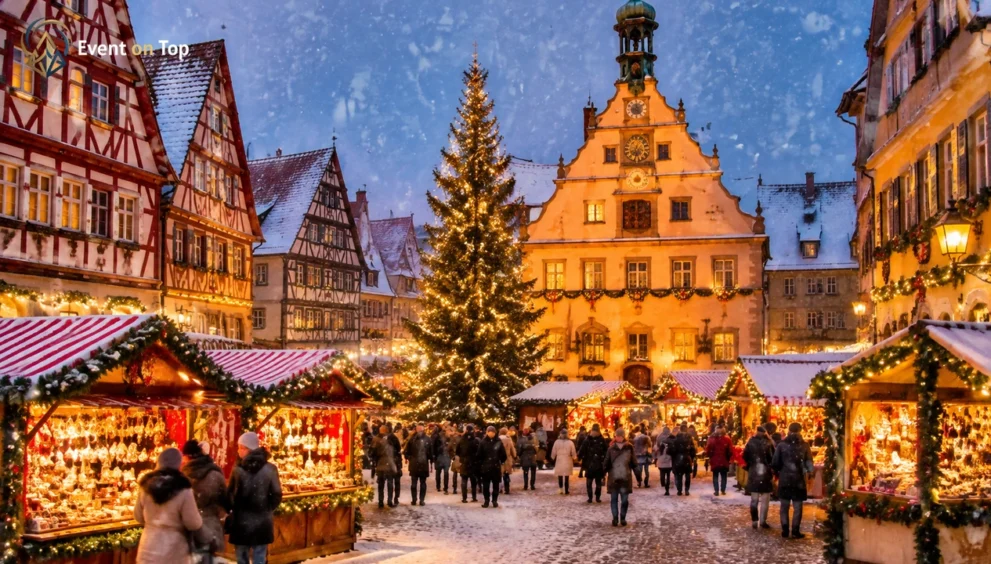
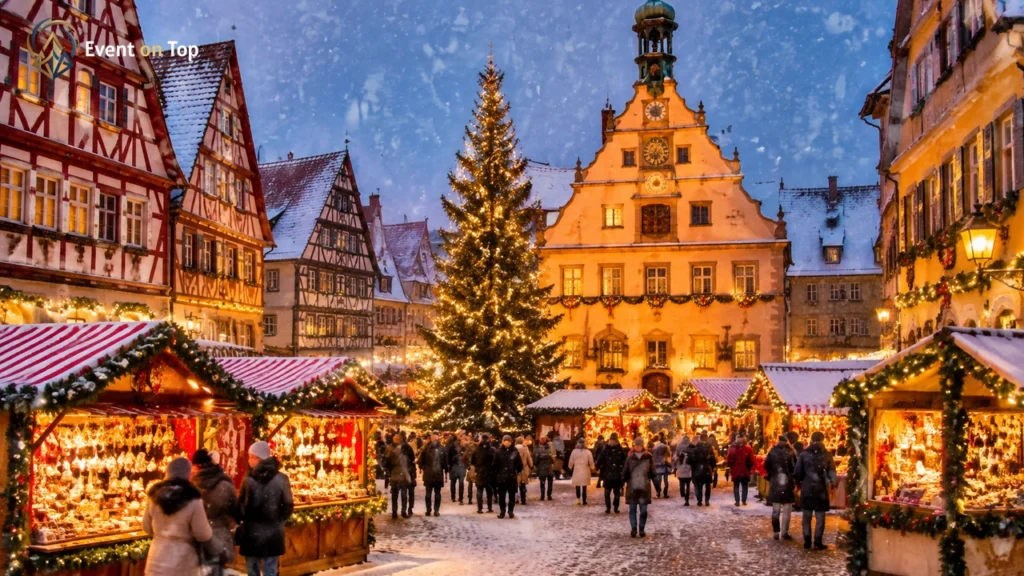
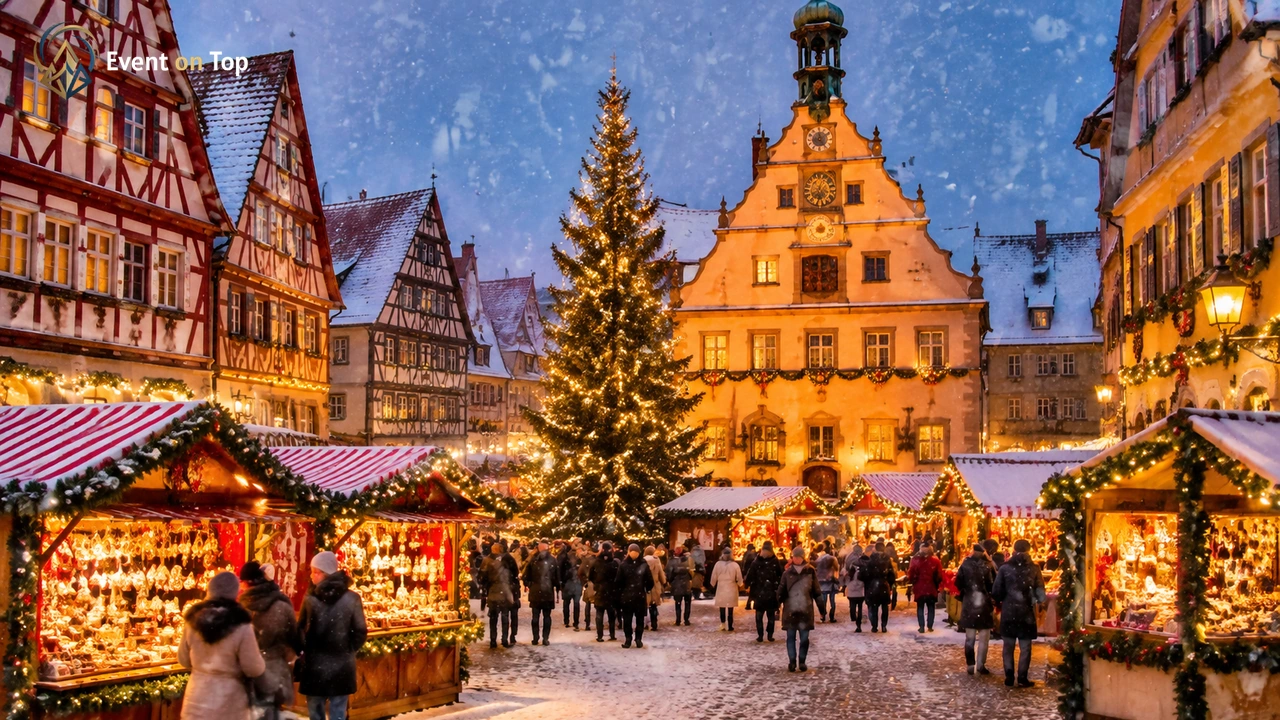
Rothenburg ob der Tauber is the town Christmas cards are drawn from: a walled medieval old town of crooked half-timbered houses, cobbled lanes and towers, wrapped around one small, beautiful Christmas market. The Reiterlesmarkt fills the Marktplatz from Friday, November 20 to Wednesday, December 23, 2026, and it is deliberately small — around 60 stalls, free to enter, done properly in an hour or two — which is exactly why it works. The town itself is the attraction, and Christmas is the season when it looks most like itself.
This is the full guide: the confirmed 2026 dates and hours, the story of the Reiterle who gives the market its name, what to eat, the year-round Christmas shop that is not part of the market at all, a walking route through the old town, a timed one-day plan, and the honest notes — including the day the market is closed and what happens after December 23, when the stalls come down. For the wider picture, see our guide to the best Christmas markets in Europe.
Christmas in Rothenburg 2026 at a Glance
- Reiterlesmarkt: Fri Nov 20 – Wed Dec 23, 2026. Closed Sun Nov 22 (Totensonntag).
- Hours: Sun–Thu 11:00–19:00, Fri–Sat 11:00–20:00. Entry is free.
- Where: Marktplatz, Grüner Markt, Kirchplatz by St. Jakob’s Church, and the town hall courtyard. Around 60 stalls.
- Opening ceremony: Fri Nov 20, 2026 — the Reiterle rides across the Marktplatz and the big tree is lit.
- Advent Sundays 2026: Nov 29, Dec 6, Dec 13, Dec 20 — the market runs on all four, and they are the busiest days.
- No market after Dec 23: there are no stalls on Dec 24, 25 or 26 — the old town goes quiet for Christmas itself.
- Käthe Wohlfahrt & the German Christmas Museum: Herrngasse, open all year — separate from the market, with their own hours.
- Christmas Day: Friday, December 25, 2026. New Year’s Eve: Thursday, December 31, 2026.
- Weather: December daytime highs of just a few degrees above freezing, nights below it, snow possible but never guaranteed. Dress for standing outside.
- Getting there: train from Nuremberg or Würzburg with a change at Steinach; by road about 115 km from Nuremberg and about 185 km from Frankfurt, on the Romantic Road.
The Reiterlesmarkt: Dates, Hours & the Story of the Reiterle
The market is called the Reiterlesmarkt after the Reiterle, the legendary horseman of Rothenburg folklore — a spectral rider who, the story goes, rides through the town in winter. The market opens with him: on Friday, November 20, 2026, the Reiterle rides across the Marktplatz and the mayor lights the big Christmas tree, and the stalls open for the season. Local tradition traces the market’s roots to the 15th century, which makes it one of the oldest Christmas markets in Germany, though the town’s own tourism site gives no founding year — the age is tradition, not a documented date, and the town does not pretend otherwise.
The confirmed 2026 dates are Friday, November 20 to Wednesday, December 23, with one closure: Sunday, November 22 is Totensonntag, the Protestant day of remembrance, and the market is closed that day. Some listings note a possible afternoon opening on Totensonntag, so if November 22 is your only day, check the town’s own programme before you travel rather than trusting either version. Hours are 11:00 to 19:00 Sunday to Thursday and 11:00 to 20:00 on Friday and Saturday, and entry is free — you pay only for what you eat, drink and take home.
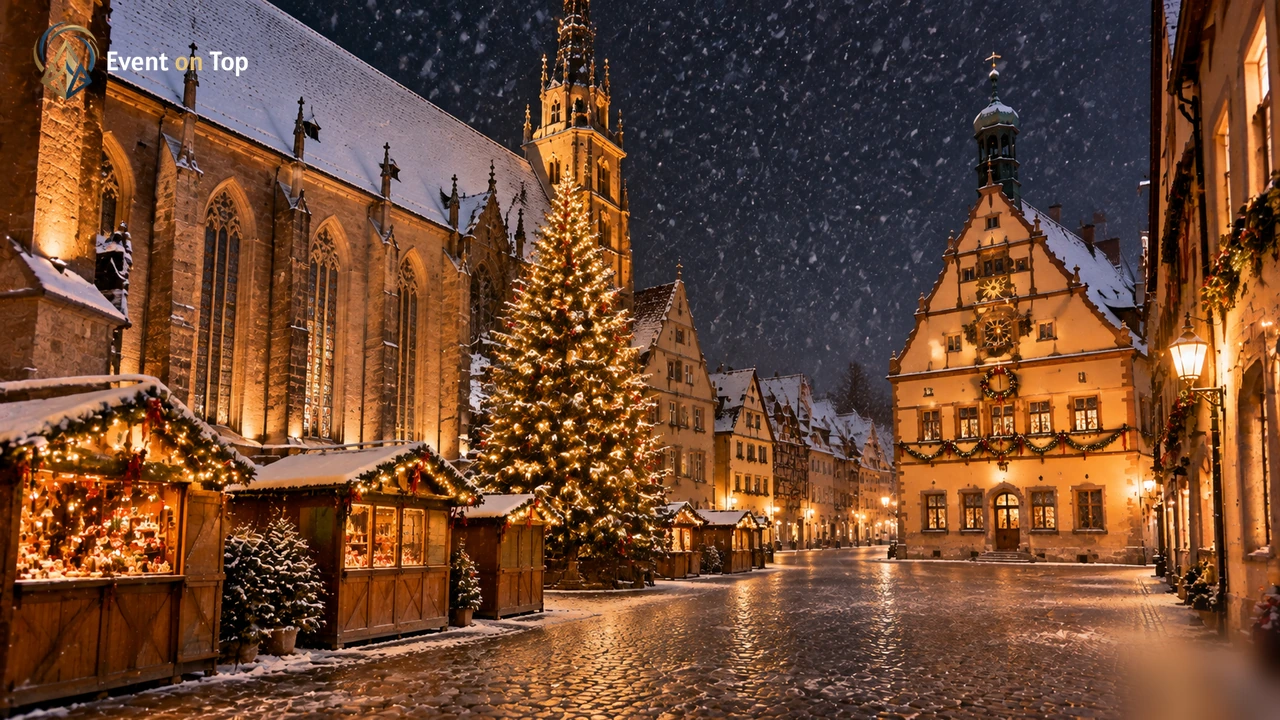
The market is spread across four connected spaces in the old town: the Marktplatz in front of the Rathaus (town hall), the Grüner Markt, the Kirchplatz by St. Jakob’s Church, and the town hall courtyard. Around 60 stalls fill them — crafts, ornaments, wooden toys, candles and food — and because the market is small, the whole thing is walkable in one slow loop. Come on a weekday morning, when the light is good for photographs and the tour groups have not arrived yet; the Advent Sundays are the opposite — the market at its fullest and its loudest, which some people love and some people should avoid.
What to Eat & Drink at the Market
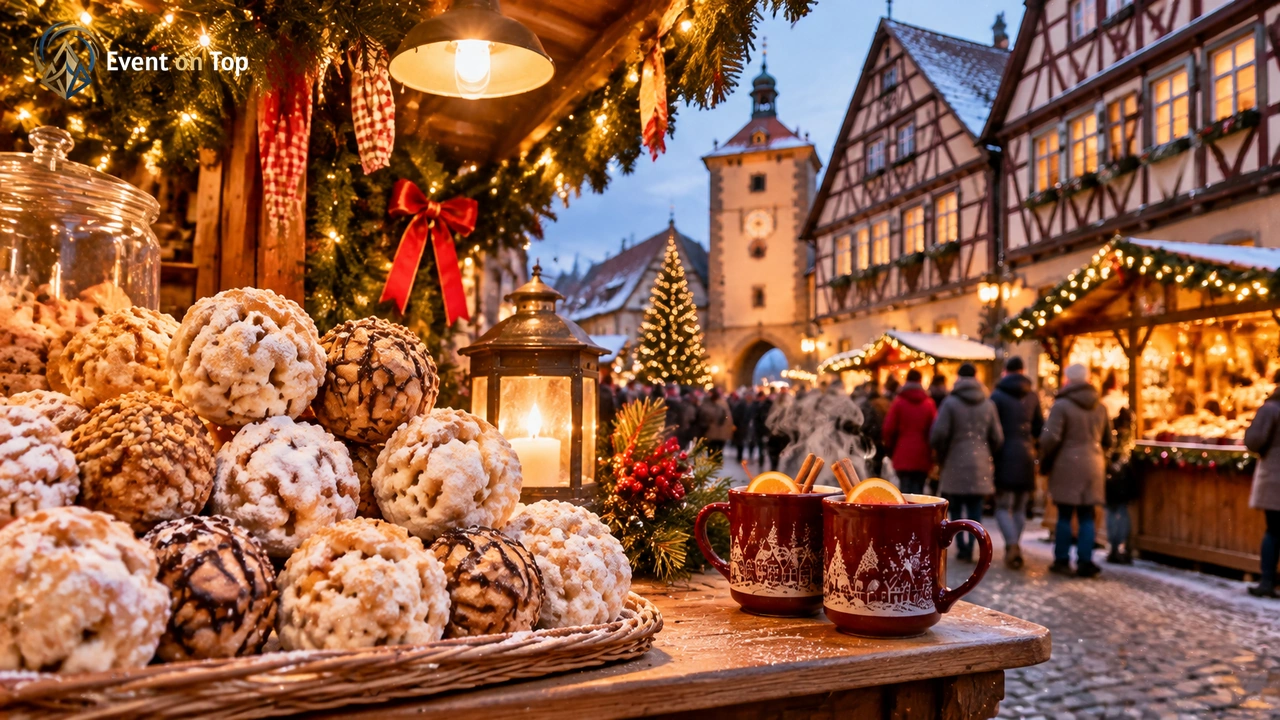
Start with the Schneeball. It is Rothenburg’s signature pastry — a ball of shortcrust dough, fried and dusted with sugar or dipped in chocolate, cinnamon or nuts — and the stalls sell it everywhere in the market. It is sweet, crumbly and filling, and one is enough to share if you are also working through the rest of the market. The town’s bakeries sell them all year, so the Schneeball is not a market exclusive, but eating one standing in the Marktplatz with cold hands is the version that counts.
The rest of the market eats the way German Christmas markets do: bratwurst from the grill, Lebkuchen (gingerbread) in every size, roasted almonds and chestnuts, potato pancakes, and mugs of glühwein to hold while you walk. The food stalls are spread across the four squares rather than gathered in one food court, so eat as you go — a bratwurst on the Marktplatz, a Schneeball on the Grüner Markt, a second glühwein by the church. Bring cash as well as a card: the bigger stalls take cards, but some of the smaller ones are cash-only.
Käthe Wohlfahrt & the German Christmas Museum
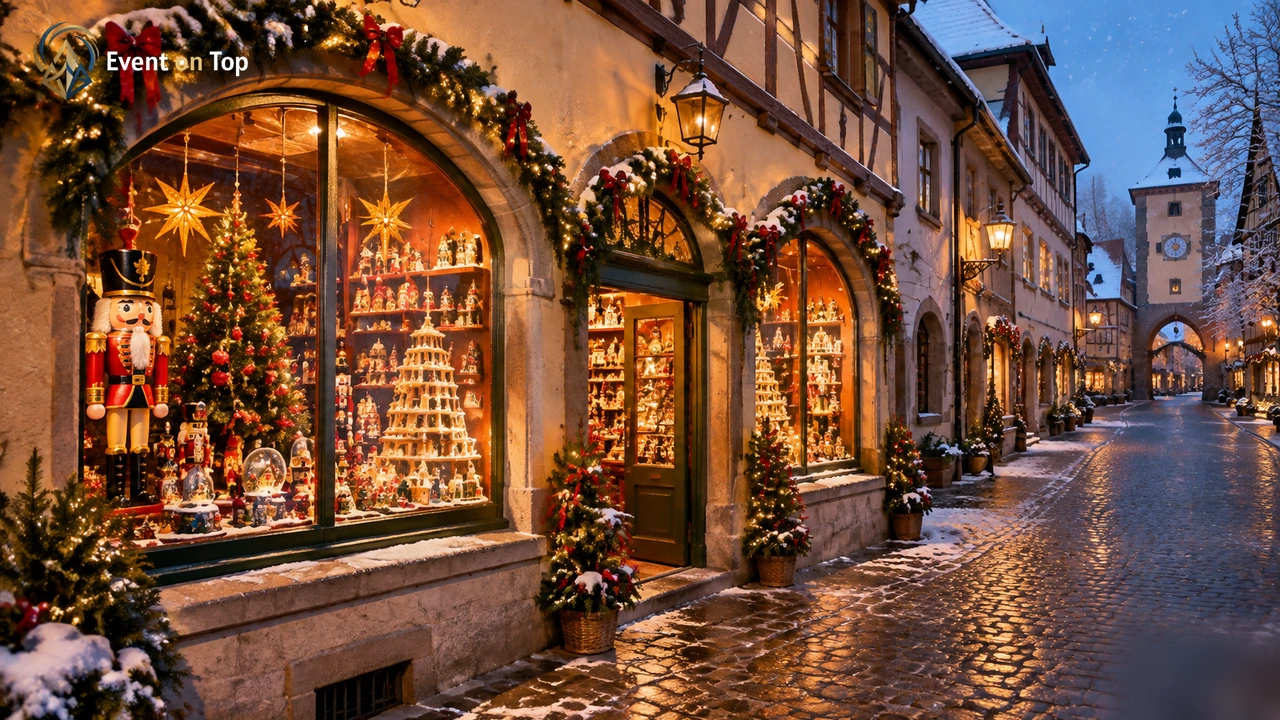
The most common confusion about Rothenburg at Christmas is also the easiest to clear up: the Käthe Wohlfahrt Christmas shop is not part of the Reiterlesmarkt. It is a year-round shop on Herrngasse, a few minutes’ walk from the Marktplatz, and it is open all year — in July as much as in December. Inside are rooms of hand-blown ornaments, nutcrackers, wooden pyramids and smokers, arranged the way a Christmas shop should be arranged, and it is worth a visit even if you buy nothing. Next door is the German Christmas Museum (Deutsches Weihnachtsmuseum), which walks through the history of Christmas traditions and decorations; it charges admission, so check its own site for current prices and hours before you go.
Because the shop is open all year, it is also the honest answer to the question of what to do in Rothenburg after December 23, when the market has gone. The stalls come down, the squares empty, and the town goes quiet — but Herrngasse still glows, the museum still opens, and the old town is still there to walk. If your trip falls on Christmas Eve, Christmas Day or Boxing Day, plan around the shop, the museum and the walk, not the market.
The Old Town Walk: Plönlein, the Walls & St. Jakob’s Church
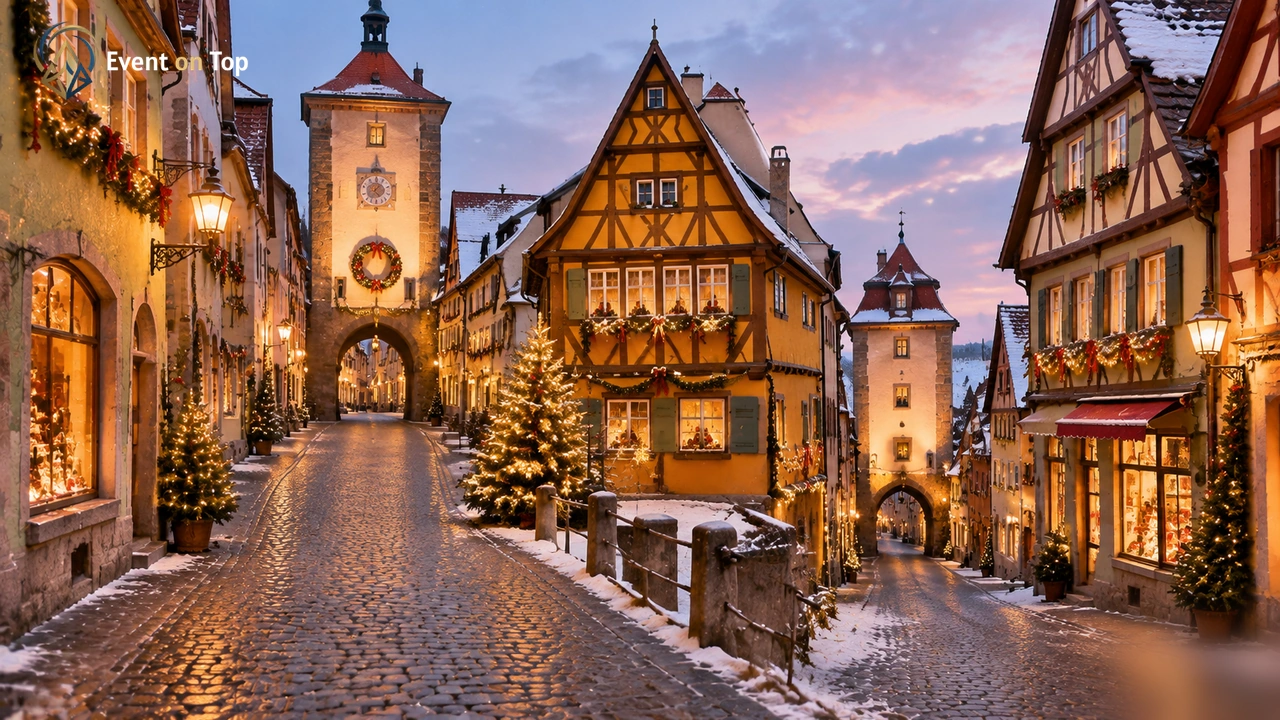
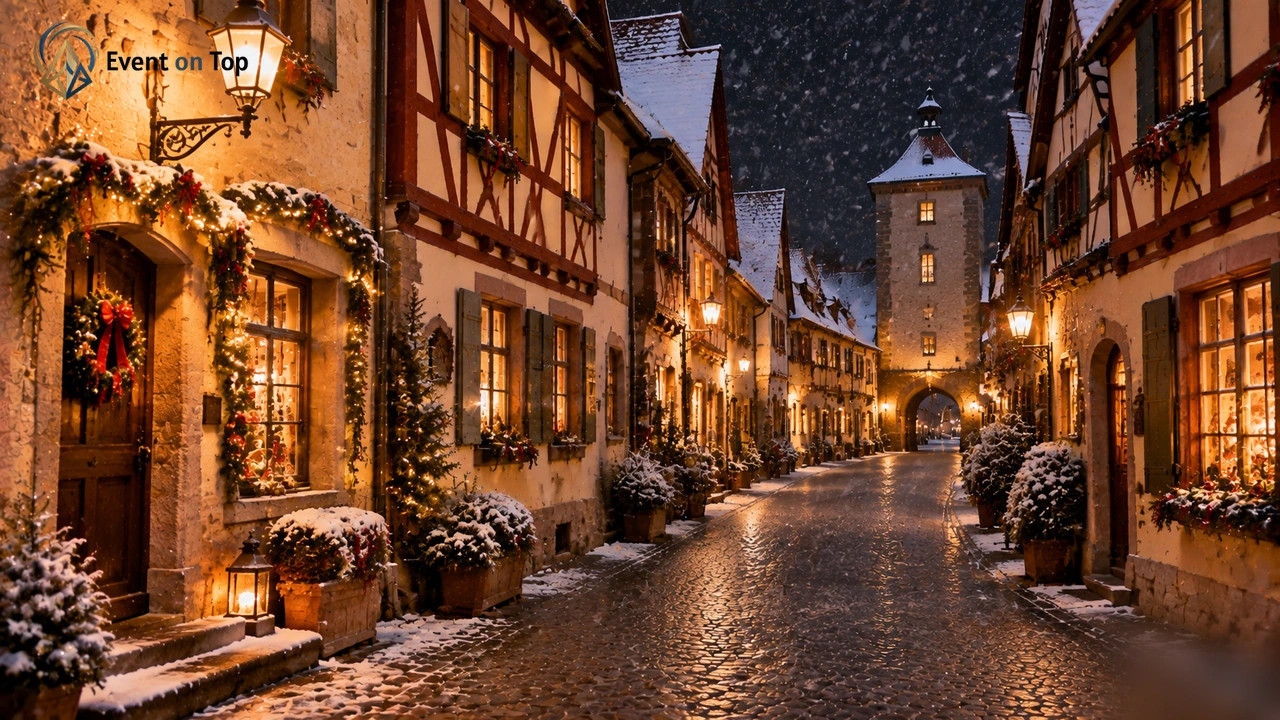
The market is the anchor, but the old town is the trip, and the walk is short enough to do properly in an afternoon. Start at the Plönlein, the fork in the road south of the Marktplatz where two lanes split around a crooked half-timbered house with a tower behind it. It is the most photographed corner in Germany, and at Christmas, with garlands on the houses and the light going early, it earns the reputation. Go early in the morning or after the market closes if you want the photograph without a crowd in it.
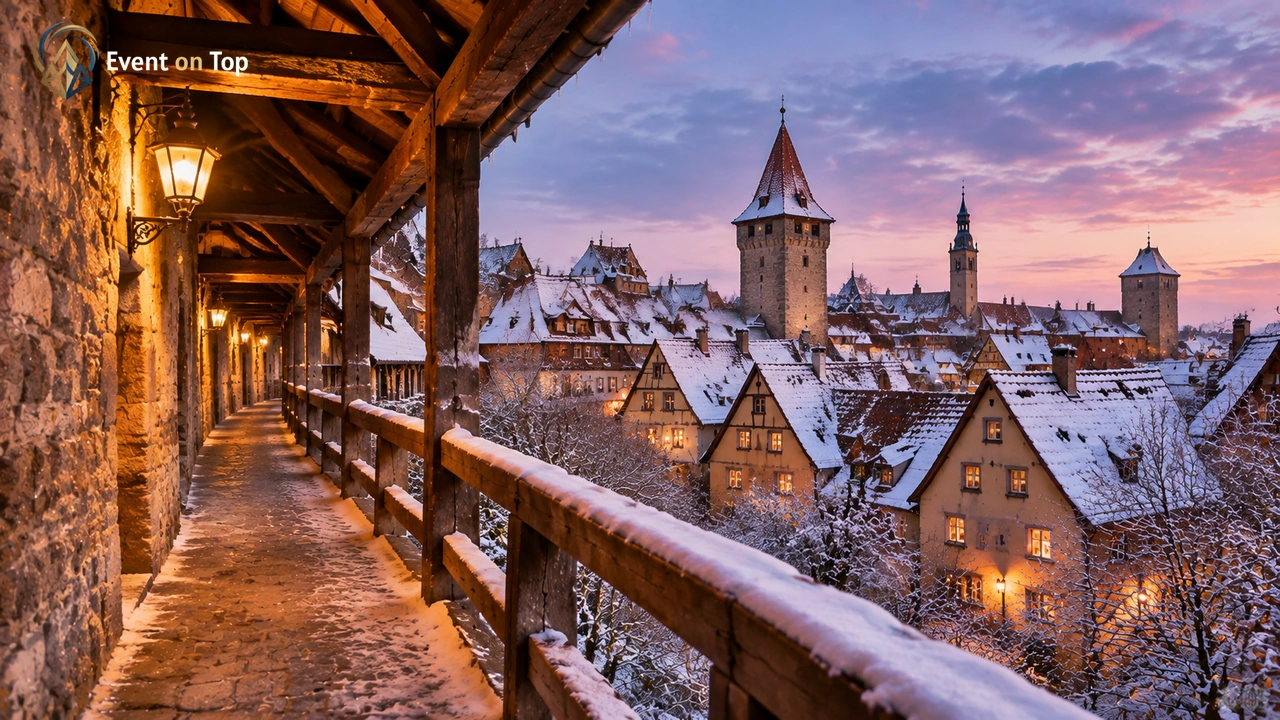
From the Plönlein, walk the town walls. Rothenburg’s medieval ramparts are walkable for about 2.5 km around the old town, with covered wooden galleries, towers to climb through, and views over the snow-dusted rooftops on one side and the Tauber valley on the other. The full circuit takes roughly an hour on foot, and it is the best way to understand the shape of the town — a walled oval, everything inside it, the valley falling away outside. Wear shoes with grip: the wall walk is wood and stone, and in December it can be icy.
Finish at St. Jakob’s Church on the Kirchplatz, at the edge of the market. Inside is the Holy Blood Altar by Tilman Riemenschneider, one of the great works of late Gothic woodcarving, and the church is quiet in a way the market square is not — a good place to sit for ten minutes when the crowds and the cold catch up with you. For a bigger Bavarian market to pair with this one, our Nuremberg Christkindlesmarkt guide covers the famous market an hour or so away.
Christmas Beyond the Market: Advent Sundays & the Quiet Days
The four Advent Sundays — November 29, December 6, December 13 and December 20 in 2026 — are the market’s biggest days, and the town plans around them: the stalls are all open, the squares are full, and the hotels inside the walls are booked solid. If you want the atmosphere, come on an Advent Sunday and arrive before 11 a.m.; if you want the town to yourself, come on a Tuesday or Wednesday in early December instead, when the market is open, the light is low and lovely, and you can walk the walls without meeting anyone.
Then the market ends, and Rothenburg changes character. Wednesday, December 23 is the last day of the stalls; from Christmas Eve the squares are empty and the town is quiet, and it stays quiet through Christmas Day and Boxing Day. That is not a failure of the trip — it is a different trip. A Christmas Day in Rothenburg is a walk on the walls, a long lunch, the Käthe Wohlfahrt shop and the museum, and an old town that belongs to the people who live there. New Year’s Eve is low-key in the same way: no big public countdown, so book a restaurant table if you want a proper dinner. If you want a market that runs through the holiday itself, our Christmas in Munich guide covers a city whose markets stay open longer.
A One-Day Christmas Plan
Morning — arrive and walk. Come in on the morning train and walk straight to the Plönlein before the day-trippers arrive, then take the wall walk while the light is still good — about an hour for the full circuit, less if you cut across the town instead. Stop at St. Jakob’s Church on the way back to the Marktplatz.
Midday — the market opens. The stalls open at 11:00. Do a slow first loop of all four squares without buying anything, then a second loop for the shopping: ornaments and crafts first, because the good handmade pieces sell out on Advent weekends, then food — a bratwurst, a Schneeball, a glühwein — eaten standing in the square, the way it is meant to be eaten.
Afternoon — Herrngasse. Walk to the Käthe Wohlfahrt shop and the German Christmas Museum while the market is at its busiest, then warm up properly in a café on the Marktplatz. If the town hall tower is open, climb it for the rooftop view before the light goes.
Dusk — the market at its best. The Reiterlesmarkt is at its best in the last hour before closing, when the lights come on properly and the stalls glow against the half-timbered houses. Stay for it — the market at dusk is a different place from the market at noon — then eat dinner inside the walls and take a late train out, or stay the night and walk the empty lanes after the stalls close. If your trip falls on November 20, be on the Marktplatz for the opening ceremony instead: the Reiterle’s ride and the tree lighting happen only once a season.
Where to Stay & Getting There
Stay inside the walls if you can. Rothenburg’s hotels and guesthouses inside the old town are small, many of them in half-timbered buildings, and staying inside means the evening walk back is through the lanes rather than across a car park — which matters when the market closes at 19:00 or 20:00 and the town goes dark and quiet. Book Advent weekends months ahead; a Tuesday in early December is usually available at short notice. If the town is full, the villages on the Romantic Road make a workable base, but you lose the evening, which is the best part.
Getting there is straightforward. Trains run from Nuremberg and Würzburg with a change at Steinach, and the trip from Nuremberg takes a little over an hour each way — which makes Rothenburg a genuine day trip from Nuremberg, and a natural pairing with its Christkindlesmarkt. By road it is about 115 km from Nuremberg and about 185 km from Frankfurt, along the Romantic Road, and the drive itself is part of the trip in December, with the Franconian countryside in the snow. Drivers should park outside the walls and walk in: the old town is small, largely pedestrian, and not built for cars, and the car parks outside the gates are a short walk from the Marktplatz. For the full German market picture, see our Munich guide and our Strasbourg guide across the border in France.
The Honest Notes
First, the size. The Reiterlesmarkt is small — around 60 stalls, an hour or two of market, not a full day — and anyone expecting a Nuremberg-scale fair will be disappointed. The honest way to plan it is as a town trip with a market in it, not a market trip with a town attached: the walls, the Plönlein, the church, the museum and the shop are the day, and the market is the glowing centre of it. If you want scale, go to Nuremberg; if you want the prettiest hour of your December, come here.
Second, the crowds. Advent weekends are busy, and the Marktplatz is small, so a Saturday in mid-December is shoulder-to-shoulder by mid-afternoon. The fix is timing, not avoidance: come on a weekday, come at 11:00 when the stalls open, or come for the last hour before closing, when the day-trippers have left and the lights do the work.
Third, the dates. The market closes on December 23, and there is nothing on December 24, 25 or 26 — no stalls, no market, no exceptions. Do not book a Christmas Day market trip to Rothenburg; book it for the weeks before Christmas, or book the quiet days knowingly, for the walls and the shop and the empty lanes. And dress for it: December in Rothenburg is a few degrees above freezing by day and below it at night, the wind comes off the Tauber valley, and the cobbles are slippery when they freeze. Warm boots, a proper coat, gloves you can hold a glühwein in. For gifts to take home from the market, our Christmas gift ideas for 2026 guide is the wider list.
FAQs: Christmas in Rothenburg 2026
When is the Rothenburg Christmas market in 2026?
The Reiterlesmarkt runs Friday, November 20 to Wednesday, December 23, 2026, on the Marktplatz, Grüner Markt, Kirchplatz and town hall courtyard. It is closed on Sunday, November 22 for Totensonntag. Hours are 11:00–19:00 Sunday to Thursday and 11:00–20:00 Friday and Saturday. Entry is free.
Is the Rothenburg Christmas market free?
Yes — entry to the Reiterlesmarkt is free, and you pay only for food, drink and what you buy from the stalls. The Käthe Wohlfahrt shop is free to browse, and the German Christmas Museum next door charges admission — check its own site for current prices.
How long do you need at the Reiterlesmarkt?
The market itself takes an hour or two, but Rothenburg needs a full day: the wall walk, the Plönlein, St. Jakob’s Church, the Käthe Wohlfahrt shop and the museum, plus the market at dusk. Staying one night inside the walls is the best version of the trip, because the old town after the stalls close is the quietest and prettiest it gets.
Can you do Rothenburg as a day trip from Nuremberg?
Yes — trains run from Nuremberg with a change at Steinach, and the trip takes a little over an hour each way, so a day trip is easy and the two markets pair naturally. Come in the morning, walk the walls and the Plönlein, do the market from 11:00, stay for the dusk lights, and take a late train back — but check the last departure before you linger over the last glühwein.
What is there to do in Rothenburg at Christmas besides the market?
Plenty: the Käthe Wohlfahrt Christmas shop and the German Christmas Museum on Herrngasse (open all year), the walkable town walls, the Plönlein, St. Jakob’s Church and its Riemenschneider altar, and the Advent Sundays. After December 23 the market is gone, but the shop, the museum and the old town walk are still there — which is why Rothenburg works even on the quiet days after the stalls come down.