



Nuremberg Christkindlesmarkt 2026: Germany’s Most Famous Christmas Market


If you visit one German Christmas market in your life, this is the one most people picture. The Nuremberg Christkindlesmarkt fills the Hauptmarkt, the main square of Nuremberg’s old town, with rows of wooden stalls under red-and-white striped cloth, in front of the Gothic facade of the Frauenkirche. It is one of the oldest Christmas markets in the world and, by most measures, the most famous: around two million visitors a year, a figure the city of Nuremberg confirmed in its own 2025 press reporting. The market’s history can be traced to the 17th century — the oldest surviving written mention dates to 1678, and the city will mark the market’s 350th anniversary in 2028.
What sets Nuremberg apart from the hundreds of other markets in our guide to the best Christmas markets in Europe in 2026 is how strictly it protects its character. Stallholders are held to traditional, often handmade goods, the Christkind herself opens the market with a prologue spoken from a church balcony, and the two foods the city is famous for — lebkuchen gingerbread and finger-length bratwurst — are everywhere. This guide covers the confirmed 2026 dates, the opening ceremony, the layout, the children’s market, what to eat and drink, and how to time your visit so the crowds do not swallow the experience.

Nuremberg Christkindlesmarkt 2026 at a Glance
| Detail | Information |
|---|---|
| Dates | Friday, November 27 to Thursday, December 24, 2026 |
| Opening ceremony | Friday, November 27, 2026, at 5:30 p.m. |
| Opening hours | Daily 10 a.m. to 9 p.m.; Christmas Eve 10 a.m. to 2 p.m. |
| Location | Hauptmarkt, old town (Altstadt), Nuremberg |
| Children’s market | Kinderweihnacht on Hans-Sachs-Platz |
| Sister Cities Market | Rathausplatz, November 27 to December 23 |
| Entry | Free |
Dates and Opening Hours for 2026
The 2026 dates are confirmed on the market’s official site, christkindlesmarkt.de: the Nuremberg Christkindlesmarkt runs from Friday, November 27 to Thursday, December 24, 2026. November 27 is the Friday before the first Sunday of Advent, which is when this market always opens — a useful rule to remember, because it means the Christkindlesmarkt starts later than many German markets and runs right up to Christmas Eve rather than ending days before it.
Stalls are open daily from 10 a.m. to 9 p.m. On the opening evening there is a short pause in trading from about 5:25 to 6:00 p.m. while the opening ceremony takes place, and on Christmas Eve, December 24, the market closes early at 2 p.m. If you are planning further ahead, the official site has already published the 2027 dates as well: November 26 to December 24.
One practical consequence of the late start: the opening weekend and the final week are the two pressure points. The market is at its most comfortable in the first full week of December, especially on weekday mornings, a theme we return to in the tips section below.
The Opening Ceremony: the Christkind’s Prolog
Every Christkindlesmarkt begins the same way, and it is the single most distinctive Christmas market opening in Germany. At 5:30 p.m. on Friday, November 27, 2026, the Christkind appears on the balcony of the Frauenkirche, high above the Hauptmarkt, and recites the Prolog — the traditional opening address that begins with an invitation to the market and welcomes young and old, rich and poor alike. As she speaks, the market lights come on and the square below falls quiet; the prologue is broadcast across the Hauptmarkt so the whole crowd can hear it.
Arrive early if you want to see her rather than just hear her. The square fills well before 5 p.m., and the best sightlines toward the balcony go first. If the opening-night scrum is not for you, the sensible alternative is to skip Friday evening entirely and come on Saturday or Sunday morning instead, when the stalls are open from 10 a.m. and you can browse before the day-trip crowds arrive — you lose nothing but the ceremony itself.

Who Is the Christkind — and Where Can You See Her?
The Christkind (Christ Child) is the traditional gift-bringer of the German Christmas, a figure whose role goes back to Martin Luther, who shifted gift-giving in his own household from St. Nicholas Day to Christmas Eve. In Nuremberg she is also the market’s living symbol — the market is named for her. She is played by a young woman from Nuremberg: candidates must have been born in the city or have lived there a long time, be between 16 and 19 years old, and be comfortable with heights, because the Frauenkirche balcony is part of the job. Finalists are put to a public vote before a jury makes the final choice, and the Christkind serves a two-year term. Her white-and-gold dress, long blond curls and golden crown are modeled on the Rauschgoldengel, the gold-foil angel that tops Christmas trees across Franconia.
Opening night is only the start of her season. According to the official market site, the Christkind has more than 170 appointments during Advent: she visits kindergartens, hospitals and homes for the elderly and disabled, gives interviews, travels to other cities’ Christmas markets as Nuremberg’s ambassador, and on Christmas Eve visits the city’s children’s hospitals with presents. For visitors, the easiest place to meet her is the Kinderweihnacht (below): from December 1, she is there every Tuesday to Friday at 2:30 p.m., invites children to ride the merry-go-round with her for free, and listens to their wish lists. She also reads fairy tales at the Sternenhaus children’s theater, and she can often be spotted making appearances around the main market on weekends.
The Market Layout: Hauptmarkt and the Little Town of Wood and Cloth
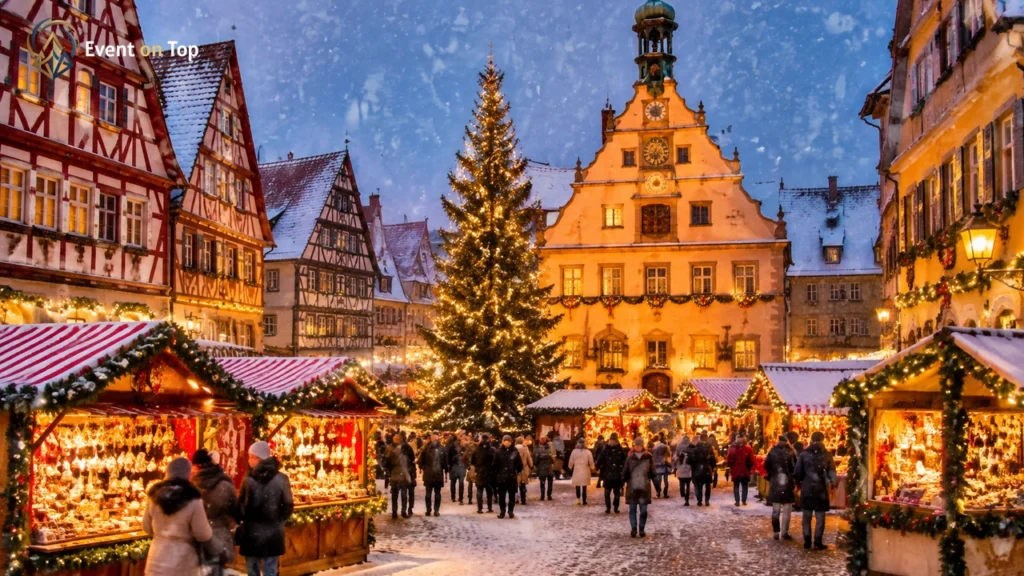
The main market occupies the whole of the Hauptmarkt in front of the Frauenkirche, with the ornate Schöner Brunnen fountain rising at its edge and St. Sebald’s church just to the north. Roughly 180 wooden stalls stand in long, orderly rows, every one of them roofed with the same red-and-white striped canvas. The uniformity is deliberate and protected: the stalls’ shared look is what gives the market its nickname, “the little town of wood and cloth.”
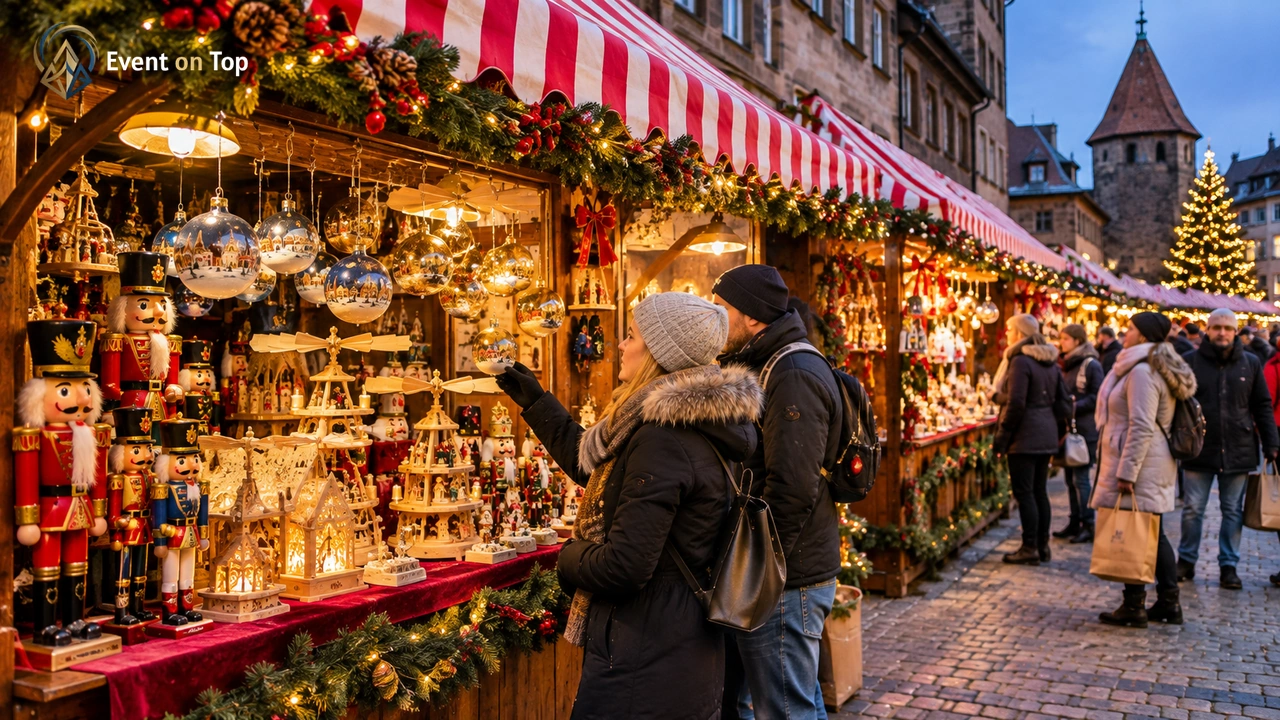
The rules behind the look go deeper than the awnings. Stallholders at the Christkindlesmarkt are admitted under a traditional goods policy: the focus is on handmade and traditional Christmas goods and regional food, and mass-produced plastic decorations, cheap imported novelty goods and recorded music are kept out — which is why the square sounds, smells and looks different from a generic winter fair. A jury from the city and the tourism board has judged and awarded the best-decorated stalls every year since 1981, so stallholders compete on craft and presentation rather than on noise. What you will actually find in the rows: hand-blown and hand-painted glass ornaments, wooden nutcrackers and Räuchermännchen (incense-smoker figures), straw stars, carved toys, beeswax candles, and stall after stall of food.
Kinderweihnacht: the Children’s Christmas Market
A few minutes’ walk from the Hauptmarkt, on Hans-Sachs-Platz, the Kinderweihnacht has been running since 1999 as the family wing of the Christkindlesmarkt. It is built at child height and child pace: a nostalgic two-tiered merry-go-round, a mini Ferris wheel and a small steam railway, plus hands-on booths where children can bake cookies, paint candles and make Christmas crafts. There is a children’s post office where letters can be sent to the Christkind, and St. Nicholas receives young visitors in his own little house.
Directly opposite, the Sternenhaus (“House of Stars”) in the Heilig-Geist-Saal hosts an afternoon program of children’s theater, fairy tales, music, ballet and magic shows, running through most of December (the city’s listing gives December 2 to 23). Between the rides, the crafts and the Christkind’s weekday visits, families can happily spend half a day here without braving the densest Hauptmarkt crowds — a difference in atmosphere that parents of toddlers will feel immediately. The official market site lists the children’s market as running on after Christmas, to December 30, with shorter hours after December 26, so it is also an option for a between-Christmas-and-New-Year trip when the main market has closed.
The Sister Cities Market on Rathausplatz
Immediately north of the Hauptmarkt, on Rathausplatz by the town hall, the Markt der Partnerstädte (Sister Cities Market) runs from November 27 to December 23, 2026 — closing a day before the main market. Its roughly two dozen stalls belong to Nuremberg’s twin cities around the world, and each sells its own region’s crafts, food and drink, from Scottish shortbread and whisky to goods from cities in Ukraine, China and Nicaragua. Many of the handmade items are sold in support of charitable projects in the partner cities. It takes ten minutes to walk it, but it is the easiest international detour in German Christmas market season and a calmer browse than the main square.
What to Eat and Drink at the Christkindlesmarkt
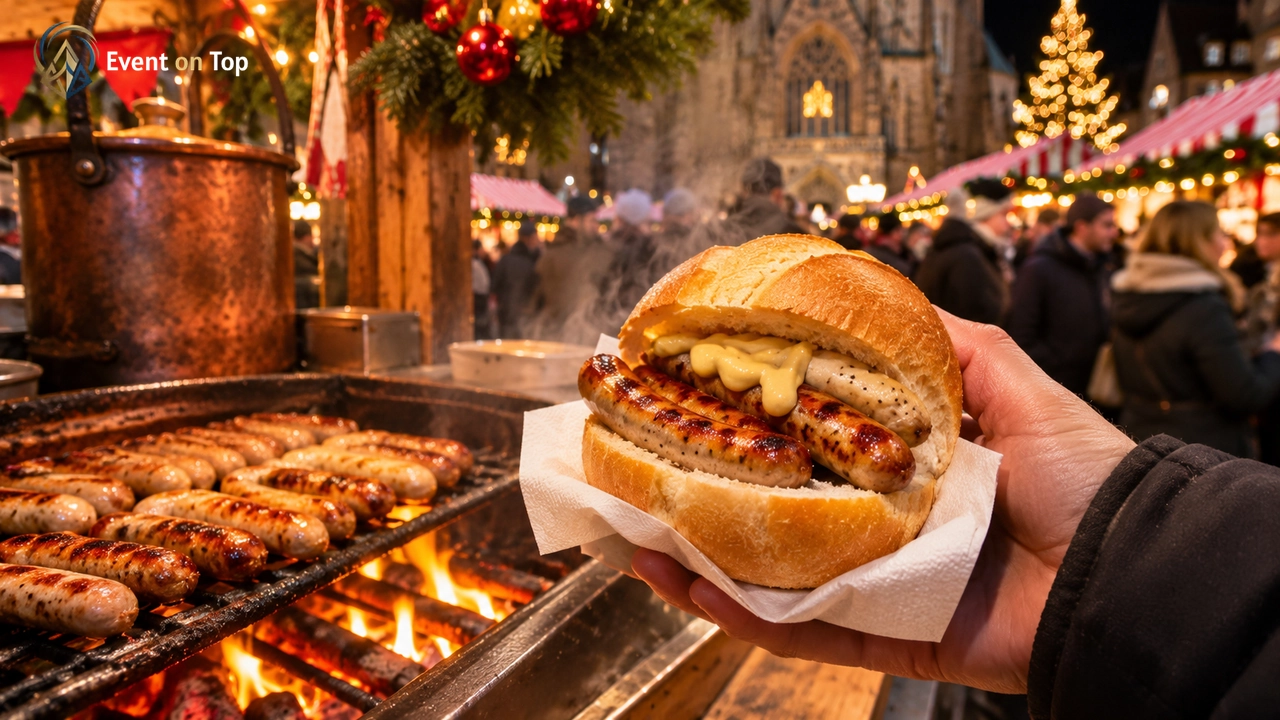
Nuremberg rostbratwurst. The city’s sausage tradition goes back more than 700 years, and the original Nürnberger Rostbratwurst is famous for being small — about the length of a finger — seasoned with marjoram and grilled over an open beechwood fire. The classic market order is “Drei im Weggla”: three sausages in a crispy bread roll, usually with mustard. The name and the sausage itself are protected, so what you get at the market stalls is the real regional article.
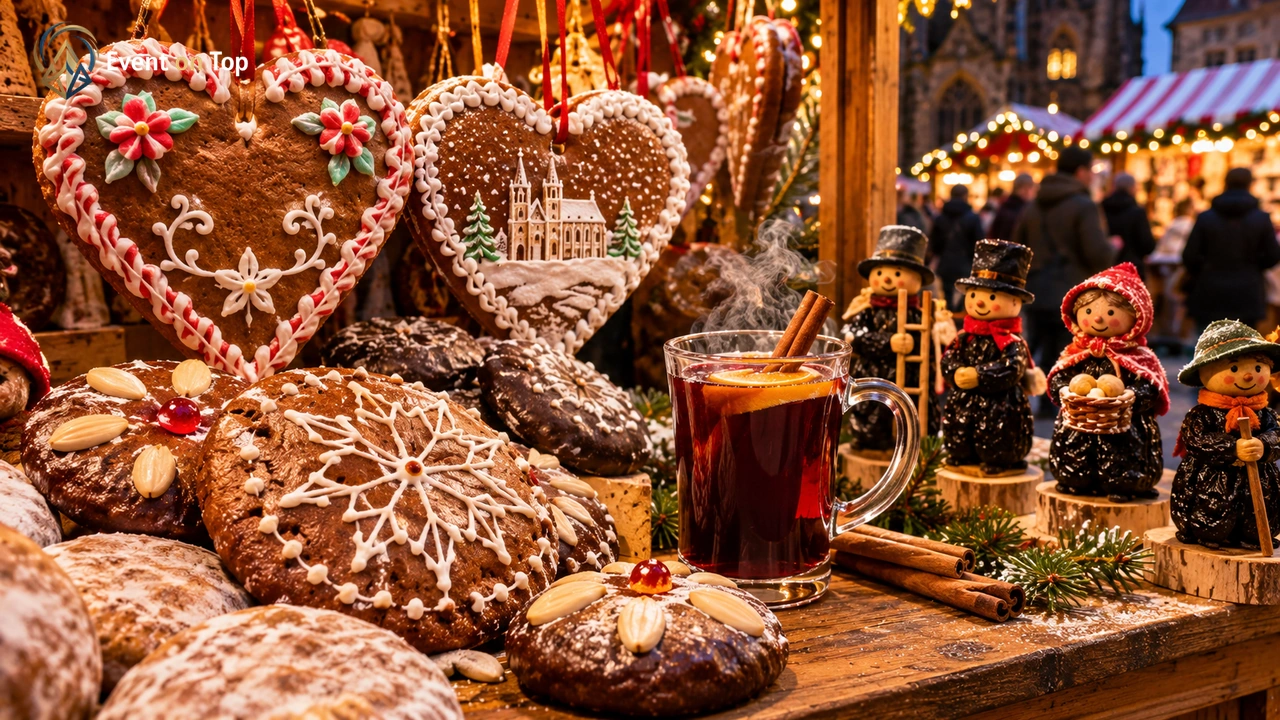
Nuremberg lebkuchen. Nuremberg’s gingerbread is soft, spiced and often baked on a thin wafer base. The premium version is Elisenlebkuchen, made with a high proportion of nuts and little or no flour, then glazed or coated in chocolate. Lebkuchen is the market’s most portable souvenir: it keeps for weeks, travels well, and is sold in sizes from a single piece to decorated presentation tins.
Glühwein and Feuerzangenbowle. Glühwein — hot spiced red wine — is served in the market’s annual mug, for which you pay a refundable deposit; hand the mug back or keep it as a souvenir. For something more theatrical, look for Feuerzangenbowle, where a rum-soaked sugar loaf is set alight and drips into the mulled wine below.
Zwetschgenmännla. The prune men are Nuremberg’s most peculiar souvenir: small figures built from dried prunes, with walnut heads and fig bodies, dressed in tiny costumes as chimney sweeps, musicians, couples and more. They have been sold at this market for generations and are meant to bring good luck — whole families of them line the craft stalls.
Beyond the famous four, expect roasted almonds, Spekulatius almond cookies (the official site name-checks them among the market’s signature treats), stollen, potato pancakes and fruit bread, which keeps well enough to take home.
Getting There and Where to Stay
Nuremberg’s Hauptbahnhof is one of Bavaria’s main rail hubs, with frequent ICE trains from Munich (about an hour), Frankfurt and Berlin, and the old town begins right outside the station. From the Hauptbahnhof it is about a 15-minute walk to the Hauptmarkt: north through the Königstor gate and up Königstraße, passing the Lorenzkirche, where the first market stalls already appear. Alternatively, take the U1 U-Bahn one stop to Lorenzkirche and cross the Pegnitz from there. Nuremberg Airport (NUE) connects to the Hauptbahnhof directly by U2 U-Bahn in about 12 minutes. Driving into the old town during the market is best avoided — the center is largely pedestrianized and saturated on market days; use a park-and-ride site instead.
For where to stay, the old town (Altstadt) puts you within walking distance of the market, and hotels there book up early for the opening weekend and Advent weekends — reserve as soon as your dates are fixed. The area around the Hauptbahnhof is the practical alternative: slightly cheaper, a straight 15-minute walk to the stalls, and ideal if you are stringing markets together by train. Nuremberg pairs naturally with a rail loop south and west: combine it with our Cologne Christmas markets 2026 guide or head across the French border with the Strasbourg Christmas markets 2026 guide for a two-country market week.
Tips for Visiting
- Go on a weekday morning. The market is calmest Monday to Thursday between 10 a.m. and noon. Friday evenings, Saturdays and the final week before Christmas are the most crowded times of the whole season.
- Book the opening night only if the ceremony matters to you. The Prolog is unforgettable, but the Hauptmarkt is at its most densely packed of the year. Arrive well before 5 p.m. for any view of the Frauenkirche balcony.
- Bring cash. Many stalls accept cards, but not all — and small food stalls, deposits and rides move faster with coins and small notes.
- Remember Christmas Eve is a half day. The market shuts at 2 p.m. on December 24, and the Sister Cities Market closes a day earlier, on December 23.
- Meet the Christkind on a weekday afternoon. Her Kinderweihnacht visits (Tuesday to Friday, 2:30 p.m., from December 1) are free and far less crowded than opening night.
- Keep bags small. The lanes between stalls are narrow and, on peak evenings, shoulder-to-shoulder; a big suitcase or backpack makes the visit miserable for everyone.

Frequently Asked Questions
When is the Nuremberg Christkindlesmarkt in 2026?
The Nuremberg Christkindlesmarkt runs from Friday, November 27 to Thursday, December 24, 2026, on the Hauptmarkt in Nuremberg’s old town. The dates are confirmed on the official market site. It opens with the Christkind’s prologue at 5:30 p.m. on November 27, and stalls are open daily from 10 a.m. to 9 p.m., closing at 2 p.m. on Christmas Eve.
Is the Nuremberg Christkindlesmarkt free to enter?
Yes. Entry to the Christkindlesmarkt on the Hauptmarkt, the Kinderweihnacht children’s market and the Sister Cities Market is free, and there is no ticket or reservation for the market itself. You only pay for food, drink, rides, workshops and whatever you buy at the stalls.
Who is the Christkind, and when can I see her?
The Christkind is a young woman from Nuremberg — elected for a two-year term from candidates aged 16 to 19 — who opens the market with the Prolog from the Frauenkirche balcony on November 27 at 5:30 p.m. During Advent she visits the Kinderweihnacht children’s market every Tuesday to Friday at 2:30 p.m. (from December 1), reads fairy tales at the Sternenhaus, and makes appearances around the main market.
What food is the Nuremberg Christmas market famous for?
The two signatures are Nuremberg rostbratwurst — small marjoram-spiced sausages grilled over an open fire, ordered as “Drei im Weggla,” three in a bread roll — and Nuremberg lebkuchen, the soft spiced gingerbread, especially nut-rich Elisenlebkuchen. Add glühwein in the market’s souvenir mug and a Zwetschgenmännla, a good-luck figure made from dried prunes, and you have the classic Christkindlesmarkt shopping list.
What is the best time to visit the Christkindlesmarkt to avoid crowds?
Weekday mornings are the calmest window: go Monday to Thursday, arrive near the 10 a.m. opening, and you will be able to browse the stalls comfortably. The busiest times are the opening ceremony on November 27, Friday evenings and Saturdays throughout December, and the last few days before Christmas Eve — if your trip is flexible, the first full week of December is the sweet spot.