









Halloween Scavenger Hunt: Free Printable Clue Sets for Kids, Teens & Adults

Halloween Scavenger Hunt: Free Printable Clue Sets for Kids, Teens & Adults
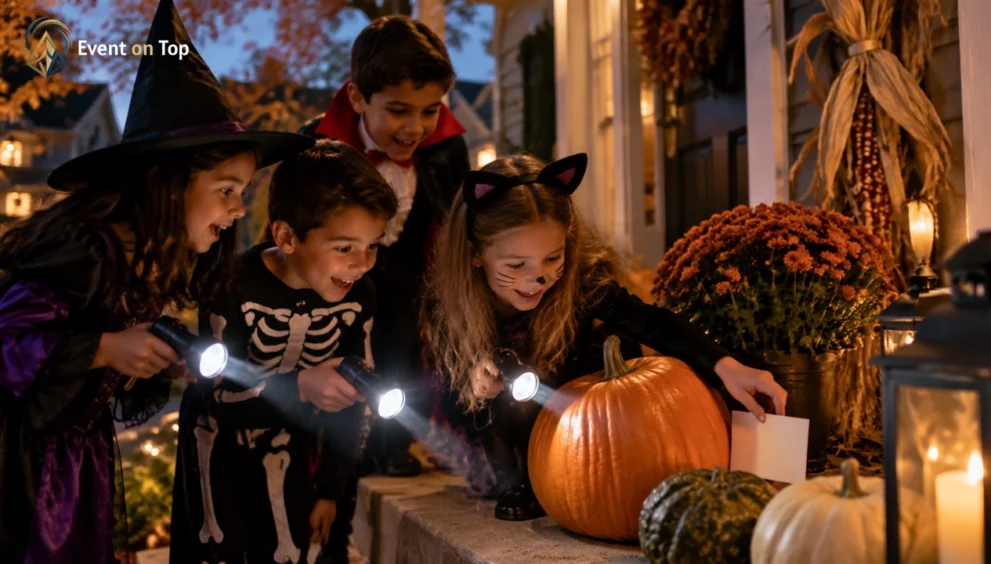
A Halloween scavenger hunt is the rare party activity that works at almost any age, in almost any space, with almost no budget — because the whole game is paper, hiding spots and anticipation. This guide gives you four complete, ready-to-run hunts you can copy or print as they are: an indoor clue chain for kids, an outdoor neighborhood hunt, a photo-challenge hunt for teens and adults, and a classroom set built for teachers. It also teaches you the simple formula behind every clue, so you can write a hunt that fits your exact house, yard or classroom in about fifteen minutes.
How a Scavenger Hunt Works (and Why Kids Love It)
There are two classic formats. In a clue chain, each card hides at the location the previous card describes, so players move step by step toward a final prize — a treat bowl, a small gift or the party itself. In a list hunt, every player or team gets the same list of items or photo challenges and races to complete it first, or to score the most points before time runs out.
Kids love hunts because the reward is not just the prize at the end — it is the small victory of figuring something out, over and over. A well-built hunt gives every child repeated moments of “I solved it!” while burning off exactly the kind of energy that makes party hosts nervous. For the host, the appeal is just as strong: a hunt runs itself for 20 to 40 minutes, costs almost nothing, and scales from three players to a whole classroom.
A few principles make any hunt succeed:
- Every clue must be solvable. If players stall for more than a minute or two, the game dies. Test each clue on the youngest player mentally before you hide it.
- End somewhere worth arriving. The final hiding spot should hold something — treats, a certificate, a glowing decoration — even if it is small.
- Keep the route safe. No clues on stairs, near roads, in kitchens with hot pans, or anywhere a running child should not be.
- Match the challenge to the age. Picture clues and single-step rhymes for under-6s; multi-step riddles and photo challenges for teens.
Indoor Clue Chain for Kids: 10 Clues, Ready to Use
This chain is written for a typical home and works for roughly ages 5 to 10. Copy each clue onto its own card or slip of paper. Hide clue 2 at the location clue 1 describes, clue 3 where clue 2 points, and so on. Hand players clue 1 to start, and hide the prize — a treat bowl works perfectly — at the final location.
- Start: “I keep your feet warm and dry, I wait by the door where you say goodbye. Look inside the pair you wear — your first clue is hiding there!” → Inside a shoe by the front door.
- “I have pages but I am not a tree, stories and pictures live in me. Find the shelf where I rest at night — your next clue is tucked in tight.” → In or behind a book on the bookshelf.
- “I am cold inside and hum all day, I keep the milk and cheese that way. Open my door and take a peek — the next clue is yours to seek.” → Inside the refrigerator (tape it to a shelf edge, not on food).
- “I am soft and square and hold your head, you rest on me when you go to bed. Lift me up and look below — that is where the next clue goes.” → Under a pillow.
- “I wash your hands and brush your teeth, I have a mirror with space beneath. Open the cabinet, quiet as a mouse — the next clue hides in the smallest room of the house.” → Under the bathroom sink or in the vanity cabinet.
- “I go tick and tock and tell the time, I hang on the wall — now end this rhyme: look right behind me, flat and sly, the next clue waits where the wall is dry.” → Behind a wall clock.
- “I am where the family gathers to eat, under the table, beneath a seat. Crawl down low and look with care — the next clue is taped under a chair.” → Taped under a dining chair.
- “I spin and I splash and I make clothes clean, I am the hardest-working machine. Peek inside my round, dark drum — your next clue is where the socks come from.” → Inside the washing machine (empty and dry, door left open).
- “I have cushions soft and a back so wide, the whole family sits on my side. Slide your hand between cushion and frame — the next clue is close to winning the game.” → Between the sofa cushions.
- “You have searched the house from floor to door, now one last riddle — can you do one more? I glow at night with a spooky grin, and treats for winners are hiding within!” → Inside or behind the porch jack-o’-lantern — the prize spot.
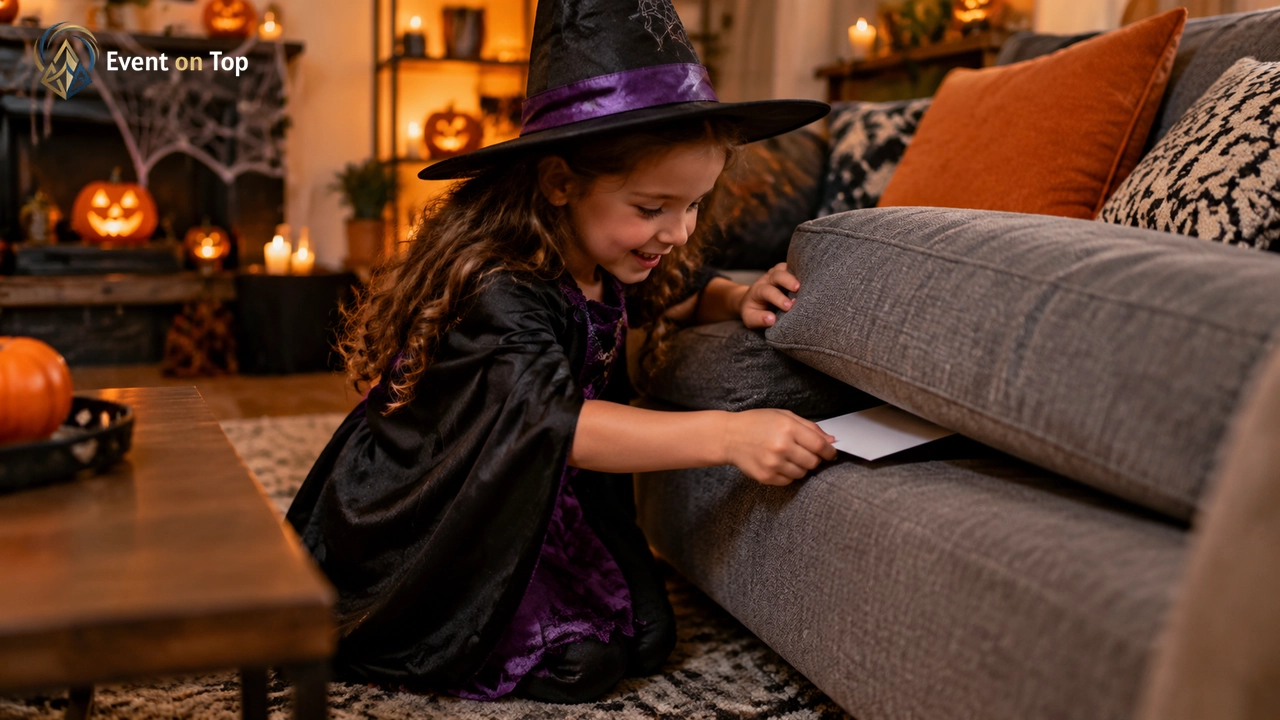
Adjusting the difficulty: For ages 4 to 6, skip the rhymes and draw a simple picture of each location instead, or read each clue aloud and let them race to the spot. For ages 9 to 12, add a twist — write every second clue in a simple code (A=1, B=2), or require the team to carry a “magic flashlight” that must shine on each clue before it can be read.
Outdoor and Neighborhood Hunt: Yard Chain Plus Spotting List
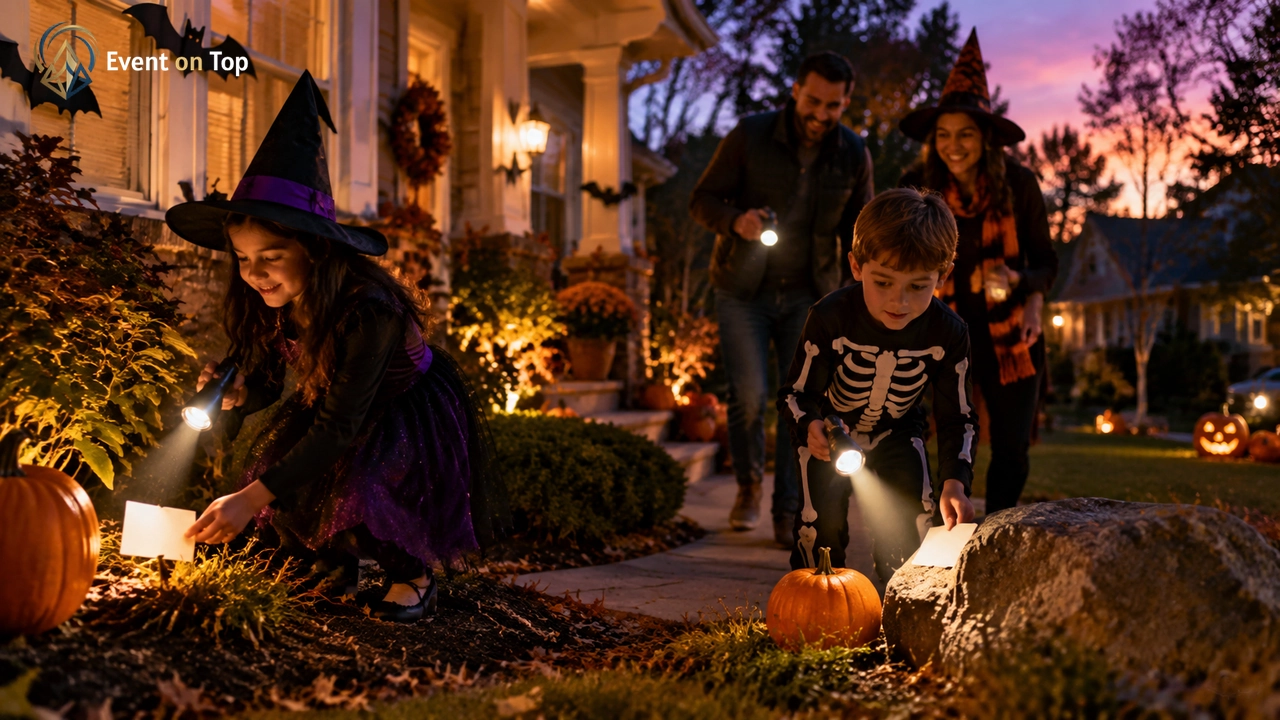
An outdoor hunt adds space, flashlights and fresh air. Run it at dusk for maximum atmosphere, and set firm boundaries first: which yards are in play, which streets are off-limits, and where an adult will be stationed. Two formats work well outside.
The Yard Clue Chain (8 clues)
Hide these around one yard or a small cluster of neighboring yards with permission:
- “Start where the postman stops each day, where letters come and bills hold sway.” → The mailbox.
- “I am round and orange and sit on the stair, with a candle or light glowing in there.” → The porch pumpkin.
- “I stand in the garden, tall and still, guarding the plants on the windowsill — check my pockets, check my hat.” → A garden statue, scarecrow or large plant pot.
- “I swing and I creak in the evening breeze, under the branches of the trees.” → A porch swing, garden bench or hammock.
- “Knock-knock — no, do not knock! Just look by the mat, behind the rock.” → Beside the front door, under the doormat or a doorstep stone.
- “I hold the water for birds to drink, splash — now what do you think?” → A birdbath (or a bucket/bowl of water if there is none).
- “Between the fence posts, spun with care, a spider’s web is waiting there.” → A decorative web on the fence or gate.
- “The final treasure, buried from view, is under the leaves — it’s waiting for you!” → A treat box under a leaf pile or autumn leaves by a tree.
The Neighborhood Spotting List (no hiding required)
For a walk-around hunt, give each team this list and a pencil. First team to spot and check off every item wins — no touching, no entering anyone’s yard, photos allowed:
- A jack-o’-lantern with triangle eyes
- A skeleton (any size)
- An inflatable decoration
- A house with orange string lights
- A spider web decoration spanning a door or window
- A ghost hanging from a tree
- A black cat (real or decoration)
- A witch hat on anything — person, skeleton or mailbox
- A “trick or treat” sign
- A pumpkin that is not orange
Teen and Adult Photo Hunt: 12 Scored Challenges
Older players do not want rhymes — they want a competition. This format uses phones: teams complete photo and video challenges against the clock, and a judge (or group vote) scores creativity at the end. Set a firm 45-minute limit, a strict boundary, and one non-negotiable rule: no knocking on strangers’ doors and no entering yards — every challenge is completable from sidewalks, your own yard and your own party space.
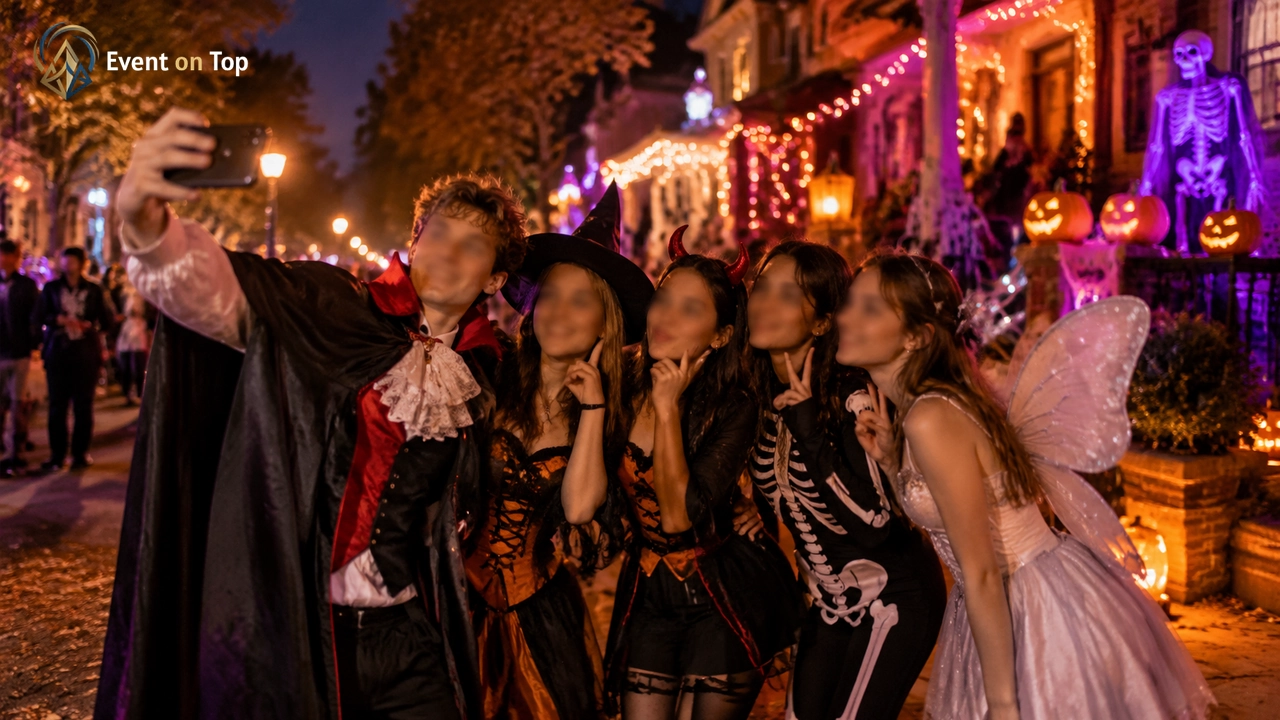
- Group selfie with a skeleton (decoration counts) — 5 points
- Recreate a famous spooky movie poster pose as a team, no props — 10 points
- Slow-motion video of your team walking like zombies toward the camera — 10 points
- A team member “holding” a full moon between their fingers — 5 points
- Spell “BOO” using only your bodies — 10 points
- Find the biggest pumpkin on the route and photograph a hand next to it for scale — 5 points
- Photo of something genuinely orange that is not a pumpkin — 5 points
- Team pyramid in front of the best-decorated house on the street (from the sidewalk) — 10 points
- A 10-second haunted-house trailer voiceover recorded over a shot of your own porch — 15 points
- Synchronized jump photo with everyone mid-air — 10 points
- Find a real spider web (not a decoration) and photograph it without touching — 5 points
- Final photo: your whole team squeezed into one doorway, in character — 10 points
Total possible: 100 points. Tie-breaker: the judge picks the funniest single photo. For an adults-only version at a party, swap two challenges for a “best costume runway walk video” and a “dramatic reading of a candy wrapper’s ingredients list” — both reliably produce the photos everyone actually keeps.
Classroom Hunt: The P-U-M-P-K-I-N Set
Teachers need a hunt that is contained, quiet-ish and finished inside 20 minutes. This set hides seven letter cards — P, U, M, P, K, I, N — around the classroom. Each clue leads to the next letter; when a team has all seven, they arrange them to spell the word, which is itself the final mini-puzzle for younger classes. Print two or three sets on different colored card so multiple teams can hunt at once without collisions.
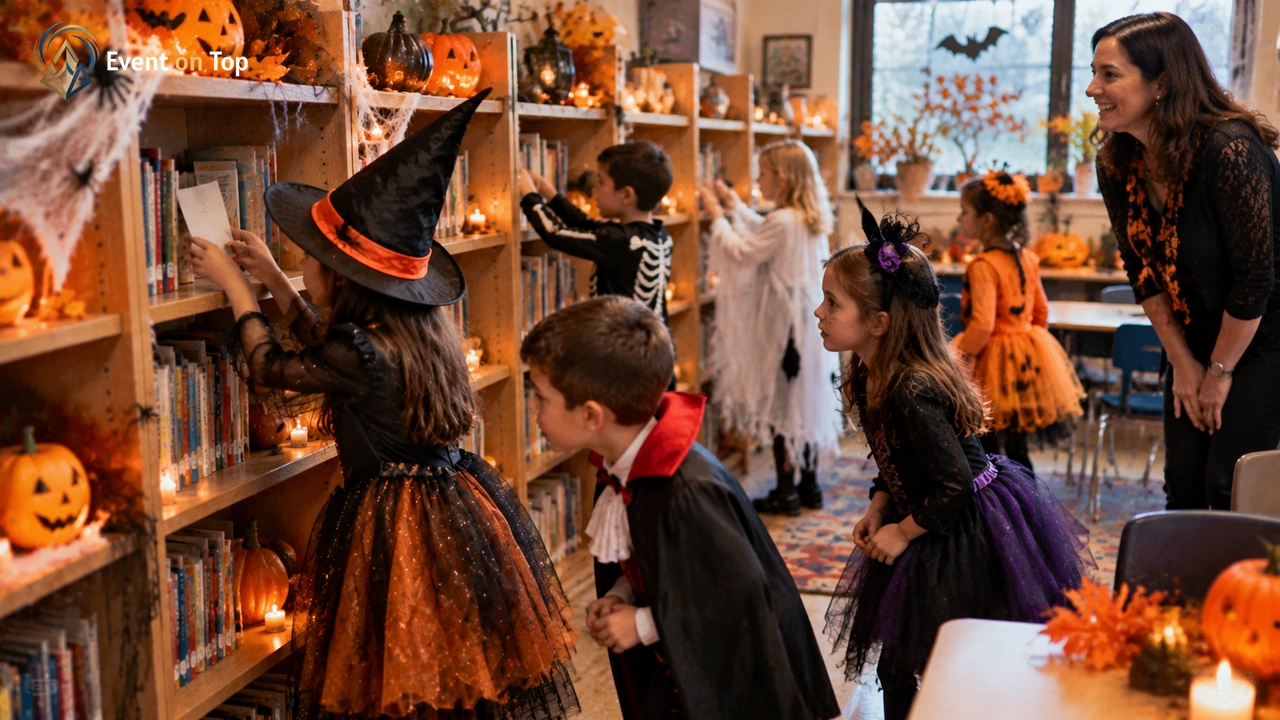
- P: “Where stories wait in rows so neat, and reading time is such a treat.” → The classroom bookshelf or reading corner.
- U: “I am where your pencils sleep, in a drawer or box they keep.” → The pencil/supply drawer.
- M: “I show the world, both land and sea, pinned up high for all to see.” → Behind or beside the classroom map or globe.
- P: “I drink the light and grow up tall, beside the window, green and small.” → The classroom plant.
- K: “Tick-tock, I am the classroom clock — no wait, look under the teacher’s dock.” → Under the teacher’s desk (the misdirect teaches careful reading).
- I: “Coats and bags hang here all day, in the hall where you put them away.” → A cubby or coat hook area.
- N: “The last letter hides where the notices go, on the board where announcements glow.” → Tucked at the edge of the notice/announcement board.
Classroom management notes: stagger team starts by two minutes so shelves do not bottleneck; make “walking feet, library voices” the official hunt rules; and keep a spare set of letters — one card will inevitably vanish into a backpack. If you are planning the full party around it, our guide to classroom Halloween party games for teachers pairs station games with this hunt, and our Halloween party ideas guide covers the home version end to end.
Write Your Own Clues: The 4-Part Rhyme Formula
Every clue in this guide follows the same build, and once you see it, you can write a clue for any hiding spot in about a minute:
- Describe the object, never name it. “I hum and I’m cold” instead of “the fridge.”
- Add one sense. A sound, a smell, a temperature — it gives solvers a second route to the answer.
- Add its job. What it does for the household anchors the riddle even if the description is tricky.
- End with a direction. “Look inside,” “look beneath,” “check behind” — the last line always tells them how to search.
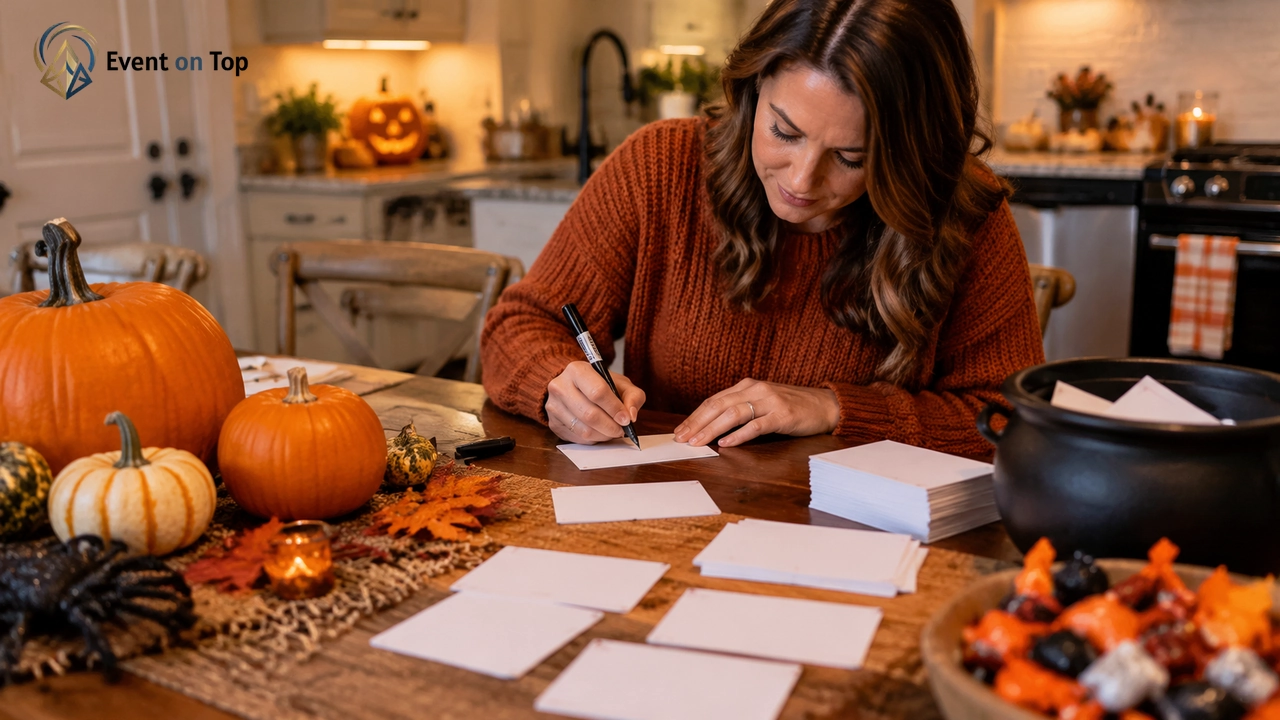
Two lines are enough for young kids; four lines suit older players. Rhyme is optional but helps memorability — and a clue that almost rhymes is funnier than one that does not try. The fastest method: walk your route first with a notebook, write the location list, then write clues at the kitchen table in one sitting. It is exactly how the sets above were built, and it is why a hunt that fits your real house beats a generic printed one.
After-Dark Safety and Fair-Play Rules
- Flashlights for every player in outdoor or dusk hunts — no exceptions, and a glow stick or reflective band for anyone crossing between yards.
- Boundaries out loud, twice. State the play area before the hunt and repeat it at the start line; younger kids genuinely forget mid-race.
- No roads, no strangers’ yards, no knocking in neighborhood formats — everything is spottable from the sidewalk.
- Adult spotters at the far ends of the route for any hunt that leaves one property.
- Check the route first for tripping hazards — hoses, decorations with guy-wires, uneven steps — especially the route to any clue hidden low.
- Prizes: every finisher gets the treat, winners get the glory. A hunt where only one child wins candy is a hunt nobody asks to play again.
FAQs
What age is a scavenger hunt best for?
Clue hunts work from about age 4 (with picture clues and adult help) through adults (with photo challenges). The sweet spot for written rhyming clues is ages 6 to 11. Scale the reading level and route length, not the concept.
How long should a Halloween scavenger hunt last?
Plan 20 to 40 minutes of play. The indoor chain above runs about 25 minutes for ages 6 to 9; the photo hunt is designed for 45 minutes including scoring. Longer is not better — end while they still want another round.
Can I run a scavenger hunt with no printing?
Yes. Write clues on index cards or sticky notes — honestly, handwritten cards feel more like a treasure hunt than printouts. The classroom set only needs seven letter cards; the spotting list can be read aloud from a phone.
What is a good prize for the end of the hunt?
A treat bowl the whole group shares, a “Master Hunter” certificate, first pick of the party snacks, or the honor of hiding next year’s first clue. Keep prizes small and shared where possible — the solving is the reward.
How do I make a hunt harder for older kids?
Add a decoding step (simple letter-number codes, backwards writing read in a mirror), hide decoy cards that send teams to a silly task before the real clue, or run two chains that cross — teams must trade one clue with each other to finish.
More Halloween Fun, Sorted
A scavenger hunt slots into almost any Halloween plan: pair it with selections from our family Halloween events guide for a full weekend, run the classroom set alongside the games in our teacher guide, or use the photo hunt as the icebreaker at an adult party from our Halloween party ideas collection.